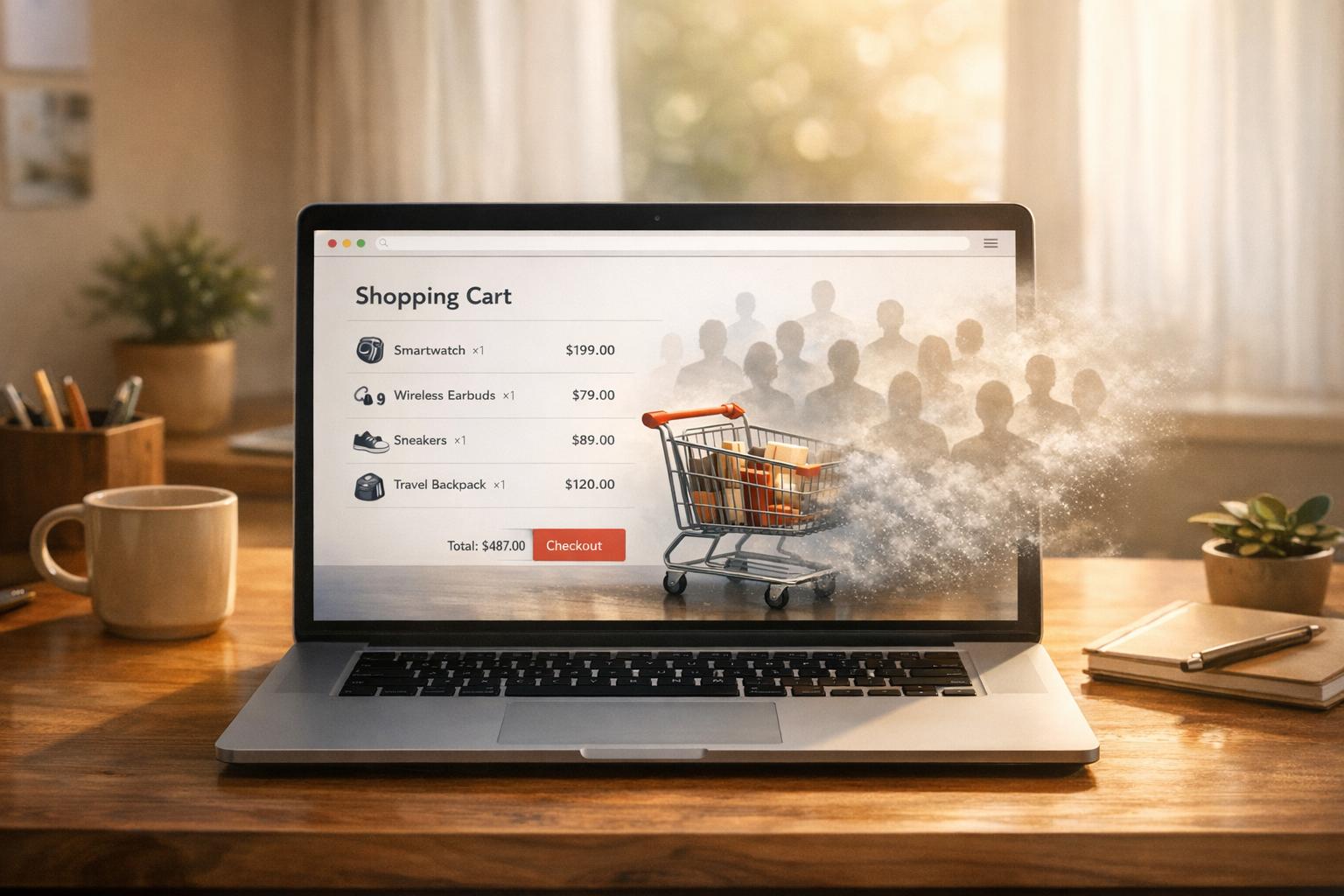
Cart abandonment happens when online shoppers add items to their cart but leave without completing their purchase. It’s a huge problem for businesses, with 70% of carts abandoned on average, leading to billions in lost revenue annually. The good news? Many of these lost sales can be recovered with the right strategies.
Key Takeaways:
- Why it happens: Common reasons include surprise costs (39%), complicated checkouts (21%), and account creation requirements (19%).
- Mobile matters: Abandonment rates are higher on smartphones (85%) compared to desktops (73%), often due to poor mobile design.
- How to fix it:
- Simplify checkout (fewer form fields, guest checkout, mobile optimization).
- Be upfront about all costs.
- Offer flexible payment options like digital wallets.
- Build trust with security badges and clear return policies.
Recovery Strategies:
- Email & SMS campaigns: Send personalized reminders with incentives.
- Exit popups & retargeting ads: Offer discounts or free shipping to bring shoppers back.
- Tools like MagicTag: Collect customer info during checkout to enable follow-ups. Businesses using MagicTag have seen conversion boosts of up to 54%.
To reduce cart abandonment, focus on simplifying the buying process, improving trust, and re-engaging customers who leave without buying. Small changes can lead to big revenue gains.
My $100M Abandoned Cart Recovery System (Shopify and Klaviyo Email Marketing)

Why Shoppers Abandon Carts
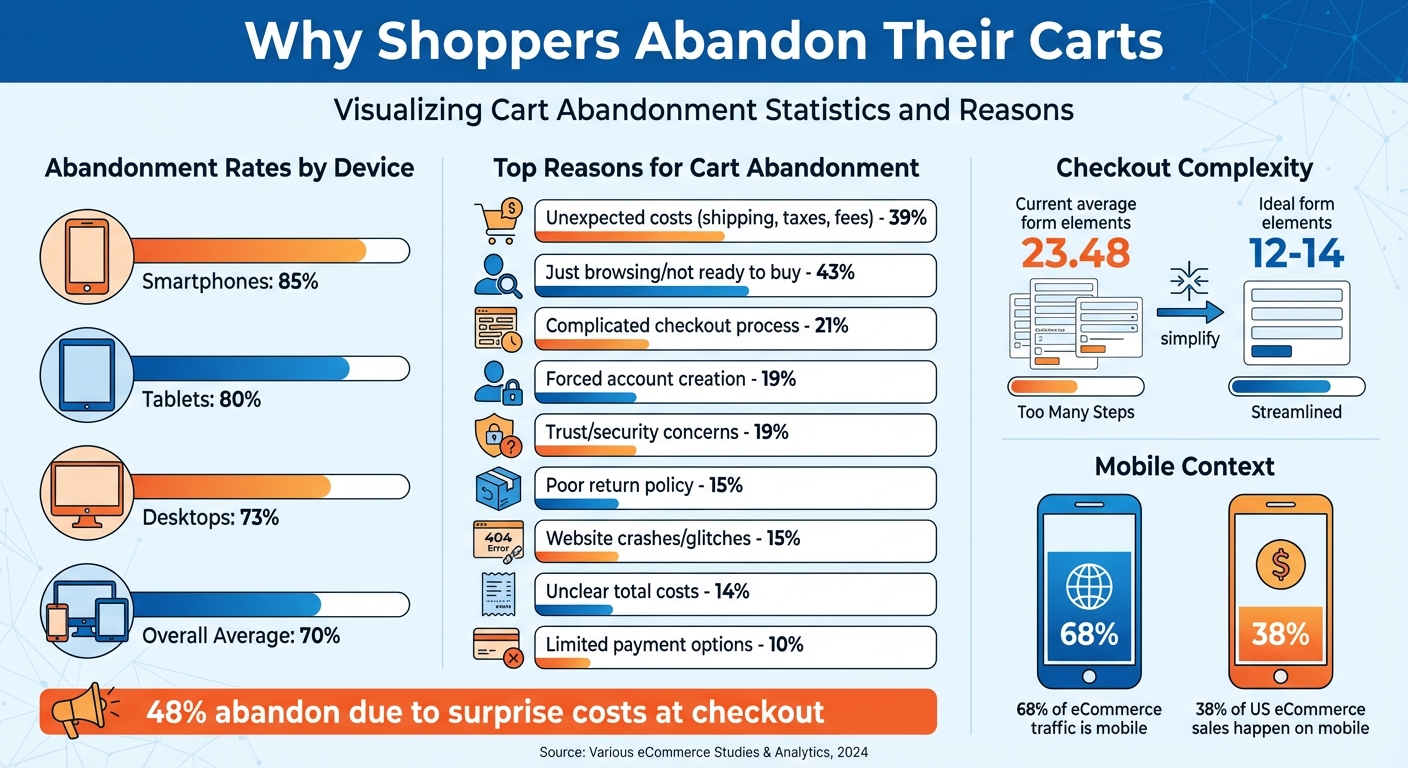
Cart Abandonment Statistics and Top Reasons Why Shoppers Leave
Common Reasons for Cart Abandonment
One of the biggest reasons shoppers abandon their carts is unexpected costs. Things like surprise shipping fees, taxes, or additional charges at checkout leave 39% of US consumers feeling caught off guard. And when customers feel blindsided, they're more likely to walk away.
Other common frustrations include slow delivery times and overly complicated checkout processes, which drive away 21% of shoppers. Then there’s the issue of account creation - 19% of people simply won’t bother completing a purchase if they’re forced to sign up for an account. Trust plays a role too: 19% of shoppers hesitate to enter their credit card details on sites they find questionable.
Here’s another surprising stat: the average US checkout process has 23.48 form elements. That’s a lot of fields to fill out, especially when the ideal number is closer to 12-14 elements.
Additional pain points include poor return policies (15%), website glitches or crashes (15%), unclear total costs (14%), and a lack of payment options (10%). While 43% of shoppers admit they’re just browsing and not ready to buy, the rest of these issues represent fixable barriers that cost businesses real revenue. By simplifying checkout flows, offering clear pricing, and optimizing for mobile, you can significantly reduce cart abandonment.
Mobile Shopping Problems
Mobile shopping comes with its own set of challenges, and the numbers paint a stark picture. Cart abandonment rates are sky-high on mobile devices - 85% on smartphones and 80% on tablets, compared to 73% on desktops. This is a big deal considering more than 38% of US eCommerce sales happen on mobile, and mobile accounts for 68% of all eCommerce traffic.
The smaller screen size is a major hurdle. Poorly designed mobile interfaces often leave users frustrated, with slow page load times further driving them away. Many stores haven’t optimized their checkout process for mobile, forcing customers to pinch, zoom, and navigate forms that were clearly designed for desktops. Typing on a phone is already a hassle, and lengthy forms without auto-fill or smart features make it even worse. Plus, the absence of mobile-friendly payment options like digital wallets adds yet another reason for shoppers to abandon their carts.
How to Reduce Cart Abandonment
Improving Product and Cart Pages
Fine-tuning your checkout process could recover up to $260 billion in lost orders across the US and EU, potentially increasing conversion rates by as much as 35.26%.
Be upfront about all costs - product prices, shipping fees, taxes, and any extras - right from the start. Surprising customers at checkout is a major turnoff, with 48% of shoppers abandoning their carts due to unexpected costs. A simple solution? Add a shipping calculator to your product pages or cart so customers know exactly what they’ll pay before committing.
Simplify your checkout process. Cut out unnecessary steps and fields - two-thirds of shoppers expect a checkout experience that takes less than four minutes. Offer a guest checkout option and enable autofill features, which can increase conversions by 50%. Forcing account creation is a dealbreaker for 26% of shoppers.
Ensure your site is fast and mobile-optimized. For example, in 2025, Kylie Cosmetics introduced a side cart feature that allowed shoppers to view their items, select free samples, and browse bestsellers without leaving the page. They also integrated Shop Pay, making the checkout process quicker and more seamless.
Provide flexible payment options like digital wallets or Buy Now, Pay Later services. Show a running total throughout the checkout process, and include a wishlist feature so customers can save items for later without feeling pressured. Also, keep distractions to a minimum - if you offer promo codes, place the entry field in a subtle location to help shoppers stay focused on completing their purchase.
A clean, efficient design becomes even more effective when paired with trust-building elements.
Building Customer Confidence
Trust issues are responsible for about 25% of cart abandonment. To ease concerns, display security badges like Norton SSL and PCI-PA-DSS certifications prominently on your site.
Use customer reviews as social proof. In 2025, Partake Foods boosted shopper confidence by featuring specific customer testimonials and a live review feed directly on product pages.
Make your return policies clear and accessible. Sanaz Hajizadeh, former director of product management at Happy Returns, emphasizes:
"When customers know that they can get their money back just as easily as they can spend it, they'll shop more confidently and spend more".
Include quick links to return policies, offer prepaid return labels, or even free returns to reassure customers.
Finally, offer live chat support during business hours to address immediate questions. For instance, Groupon combines a detailed FAQ section with a customer promise to build trust and reduce hesitation.
sbb-itb-77d5bc3
How to Recover Abandoned Carts
Email and SMS Recovery Campaigns
Abandoned cart emails are automated messages sent to shoppers who leave items in their carts without checking out. These emails aim to re-engage customers by offering personalized incentives to complete their purchase. Similarly, SMS campaigns create a sense of urgency by delivering direct, timely messages to customers' phones. By tailoring these messages with specific buyer details, businesses can make their recovery efforts more effective.
For these campaigns to work seamlessly, integrating real-time lead capture is a crucial step.
Capturing Lead Data with MagicTag

Recovery campaigns rely on having customer information, and this is where MagicTag comes into play. This tool captures email addresses, phone numbers, and other details in real time as customers type them in - even if they leave before completing their checkout. MagicTag collects data at every stage of the checkout process, from the cart summary page to the payment screen, providing multiple chances to secure customer information. Unlike traditional checkouts, MagicTag ensures customer data is captured immediately, allowing businesses to launch follow-up campaigns without delay.
Take Oleum Cottage, for example. After implementing MagicTag, they saw a 54% increase in conversion rates and managed to speed up their checkout process by five times, enabling more targeted follow-ups. Similarly, VS Mani & Co. reported a 27% boost in order conversions thanks to MagicTag’s ability to auto-fill contact and delivery details. Another success story comes from Barosi, which achieved a 35% increase in conversions by streamlining their checkout process and disabling Cash-on-Delivery for high-risk users.
Retargeting Ads and Exit Popups
Beyond direct communication, on-site tactics like retargeting ads and exit popups can help reclaim abandoned carts.
Exit-intent popups, which detect when a shopper is about to leave the site, offer last-minute incentives such as discounts, free shipping, or time-sensitive deals. For instance, an online bookstore used an exit popup to highlight free shipping alongside a limited-time discount, encouraging customers to complete their purchase. In another case, a German household appliance brand responded to customers highlighting product names - likely for price comparison - by offering surprise coupon codes, prompting immediate conversions.
Retargeting ads, on the other hand, follow customers after they leave the site. These ads appear on platforms like Facebook and Instagram, showcasing the exact products left behind and often including exclusive offers to entice shoppers back. For example, an East Asian fashion retailer used flashing tab notifications to remind users of their abandoned carts, successfully re-engaging them.
Tracking and Improving Recovery Results
Metrics to Track
Keeping an eye on the right metrics can help you understand where sales are slipping through the cracks and how to win them back. One key metric is cart abandonment rate (CAR). You can calculate it using this formula: CAR = [1 – (completed cart count ÷ total cart count)] × 100. On average, cart abandonment rates hover around 70.19%, but for many industries, a healthier range is between 50% and 65%.
Another important figure is the recovery rate - the percentage of abandoned carts that are converted through follow-up efforts. Studies show that improving the checkout process alone can boost conversion rates by 35.26%. Additionally, tracking which products are most frequently abandoned can reveal problem areas in your catalog, helping you address potential issues.
These metrics provide a foundation for refining and improving your cart recovery strategies.
Testing and Optimization
Testing different recovery strategies is essential to find what resonates with your audience. For example, try sending the first recovery email within 30–60 minutes of abandonment, followed by 2–3 additional emails in a sequence. Keep a close watch on unsubscribe rates to ensure your messages don’t overwhelm customers.
Subject lines also play a huge role in the success of abandoned cart emails. Interestingly, 60% of successful subject lines avoid overused phrases like "cart", "complete your purchase", or "did you forget something?". If you’re offering a discount, make sure it’s clearly stated in the subject line. When testing discounts, use control groups to measure the true impact of your offers and avoid conditioning customers to expect discounts every time.
Scarcity can be a powerful motivator, with 44% of cart abandonment emails using it effectively, compared to just 11% that incorporate humor. Experiment with different calls to action too - phrases like "complete your purchase" often perform better than generic ones like "return to cart".
Using MagicTag Analytics
To take your recovery strategies to the next level, consider using MagicTag’s real-time analytics. Their dashboard offers valuable insights into customer behavior during the checkout process. For instance, it can identify where users drop off in forms, helping you pinpoint and fix friction points in your checkout flow. These insights allow you to fine-tune your recovery campaigns, tailoring your timing, messaging, and offers based on real user behavior. You can even dive into product-level data to identify trends and make more informed adjustments. With this data-driven approach, you’ll be better equipped to improve your recovery results.
Conclusion
Cart abandonment is an issue that touches every stage of the customer journey. Tackling it effectively means blending prevention, real-time action, and follow-up strategies after abandonment happens. Whether it's fine-tuning your product pages, simplifying the checkout process, or running targeted email campaigns and retargeting ads, each tactic contributes to winning back potential customers.
Think of cart recovery as an ongoing effort rather than a one-and-done solution. As customer expectations evolve and market trends shift, keeping a close eye on your metrics becomes essential for long-term success.
Tools like MagicTag can make a big difference by capturing lead data in real time during checkout. This feature allows you to uncover up to 12x more leads compared to traditional methods. Plus, it integrates seamlessly with your CRM, enabling automated follow-ups. MagicTag’s real-time dashboard also gives you a clear view of where customers drop off, so you can fine-tune your recovery campaigns with precision.
Using real-time data helps you make smarter, faster adjustments to your strategies.
By combining streamlined checkout processes, personalized recovery emails, and well-planned retargeting, you create a system that constantly improves itself. The payoff? Recovered sales, boosted revenue, and more customers completing their purchases.
Experiment, analyze, and let the data guide you. While cart abandonment is a challenge that comes with e-commerce, these strategies can turn lost sales into reclaimed revenue.
FAQs
What are the best ways to reduce cart abandonment on mobile devices?
To cut down on cart abandonment on mobile devices, aim for a checkout process that's easy and hassle-free. Keep the steps to a minimum and provide convenient payment methods like Apple Pay or PayPal. Make sure pricing, taxes, and shipping fees are clearly displayed early on to avoid surprises.
Including trust-building elements like security badges, clear return policies, and accurate delivery timelines can help put customers at ease. You can also use mobile-friendly prompts such as push notifications or exit-intent popups to nudge shoppers to complete their purchase. Sweetening the deal with limited-time offers or free shipping can be just the push they need to place their order.
What are the best ways to recover abandoned shopping carts?
Recovering abandoned shopping carts is a smart way to reclaim lost sales and keep customers coming back. Here are some effective approaches to tackle this issue:
- Send automated recovery emails: A well-timed, personalized email reminding shoppers about the items they left behind can nudge them to complete their purchase.
- Provide incentives: Discounts, free shipping, or special limited-time deals can give customers the extra push they need to return and place an order.
- Streamline the checkout process: Make sure your checkout process is simple, with as few steps as possible and clear instructions to avoid frustration.
- Use exit-intent pop-ups: Just as customers are about to leave, a pop-up offering a discount or friendly reminder can grab their attention and encourage them to stay.
- Be upfront about costs: Clearly display all fees, taxes, and shipping costs right from the start to avoid unpleasant surprises that might drive buyers away.
By blending these strategies, businesses can not only recover lost sales but also offer a more seamless and enjoyable shopping experience.
How do unexpected costs contribute to cart abandonment?
Unexpected expenses - like steep shipping charges, unexpected taxes, or hidden fees - can leave customers feeling blindsided and annoyed. These unwelcome surprises are a major reason why many shoppers abandon their carts before finalizing a purchase.
The solution? Be upfront about costs. Display all charges clearly from the start to build trust. Additionally, offering perks like free shipping or flat-rate options can ease concerns, making customers more likely to complete their orders.