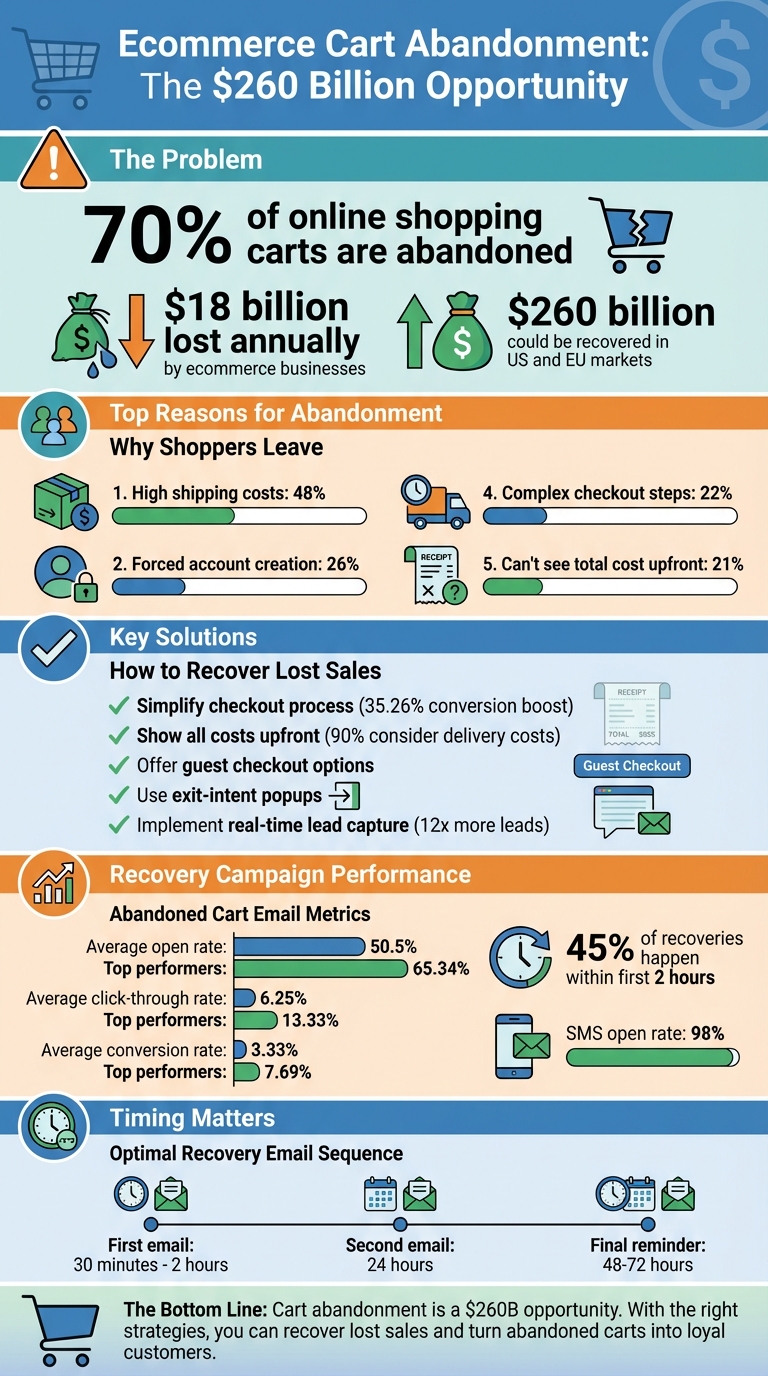
Did you know that 70% of online shopping carts are left behind? That’s billions of dollars in potential revenue slipping away every year. Cart abandonment happens when shoppers add items to their carts but leave without completing the purchase. The good news? Many of the reasons shoppers abandon their carts - like high extra costs, complicated checkouts, or account requirements - are fixable.
Here’s what you need to know:
- Top reasons for abandonment: High shipping costs (48%), forced account creation (26%), and slow delivery times (23%).
- Impact: Ecommerce businesses lose $18 billion annually, but improving checkout experiences could recover up to $260 billion in the US and EU.
- Solutions: Simplify checkout, show all costs upfront, and use tools like exit-intent popups or MagicTag to collect shopper info in real time.
Ecommerce Cart Abandonment Statistics and Recovery Strategies
My $100M Abandoned Cart Recovery System (Shopify and Klaviyo Email Marketing)

How to Reduce Cart Abandonment
Tackling the reasons behind cart abandonment can help you reclaim lost sales. Many of these issues can be resolved by making checkout smoother and addressing common pain points, creating a more seamless shopping experience.
Simplify Your Checkout Process
A complicated checkout process can frustrate customers and drive them away. In fact, requiring account creation is a major contributor to cart abandonment, while overly complex checkout steps account for 22% of abandoned carts. The fix? Streamline the process.
- Offer a guest checkout option so shoppers can complete their purchase without registering.
- Reduce the number of form fields to only what’s absolutely necessary.
- Consider implementing a single-page checkout to minimize steps.
Adding progress indicators can also make a big difference, as they guide customers through the process. Take Lego, for example - they allow users to check out as guests, returning customers, or new registrants, offering flexibility that keeps shoppers moving forward.
For mobile users, who make up about one-third of all online payments, ensure your checkout page is fully responsive. Features like optimized spacing, easy-to-tap buttons, and a sticky "Place Order" button that stays visible as they scroll can make a huge impact. In fact, improving checkout design alone can boost conversion rates by 35.26%.
Show All Costs Upfront
Unexpected fees are a dealbreaker for many shoppers. Nearly half (48%) of online buyers abandon their carts due to high extra costs like shipping, taxes, or other fees. Another 21% leave because they can’t see the total cost before checkout. Transparency is key to maintaining trust.
Make sure to display all costs - shipping, taxes, and additional fees - as early as possible. Ideally, this information should appear on product pages or in the cart summary before the checkout begins. Since 90% of online shoppers consider delivery costs when making a purchase decision, being upfront about these details is essential.
If you offer free shipping, highlight it prominently across your site. A shipping calculator can also help customers estimate costs before they commit.
For example, Every Man Jack uses a free shipping bar at the top of their cart, showing shoppers exactly how much more they need to spend to qualify for free delivery.
Additionally, provide a detailed order summary that breaks down everything - product prices, shipping, taxes, discounts, and fees. This level of transparency reassures customers and can even encourage them to increase their order value.
Use Exit-Intent Popups
Exit-intent popups are a smart way to grab a shopper’s attention just as they’re about to leave. These popups are triggered by mouse movements, like when the cursor moves toward the back button or address bar, giving you one last chance to engage.
The key to success here is timing and relevance. While generic, overly frequent popups can be annoying, a well-targeted popup offering a small discount, free shipping, or a time-sensitive deal can make all the difference. You can also use these popups to capture email addresses, enabling you to follow up later with recovery campaigns.
Keep the message simple and focused. For instance, if high shipping costs are a common objection, offer free shipping. If the total price is a concern, provide a first-time buyer discount. The goal is to remove the final hurdle between the shopper and their purchase - but without coming across as pushy or disruptive.
Capturing Lead Data from Abandoned Carts with MagicTag
Recovering abandoned carts goes beyond just having a smooth checkout process and clear pricing. Even with these in place, some shoppers will still leave their carts behind. The key is to capture their information before they leave and re-engage them quickly. Traditional methods often fall short, as they only collect data when a customer submits a form - missing out on those who abandon their carts before hitting "Place Order." That’s where MagicTag steps in.
How MagicTag Works
MagicTag captures customer details - like names, emails, and phone numbers - in real time as they type, even if they never complete the checkout process. This means you’re building a lead list of people who showed real interest in buying, not just casual visitors.
The best part? MagicTag works on any website and doesn’t require a developer for setup. Once installed, it runs effortlessly, syncing data instantly with your CRM or marketing tools through webhooks or APIs. Instead of waiting for form submissions, you’re collecting leads the moment they engage with your checkout. This method can uncover up to 12x more leads compared to relying solely on completed forms, giving you a much bigger pool of potential customers to win back.
MagicTag Features and Pricing
MagicTag is designed to be simple, effective, and compliant. It adheres to GDPR and LGPD standards, ensuring data is collected responsibly. Installation is quick, and integrations connect seamlessly with your existing CRM and marketing platforms. Plus, a real-time dashboard allows you to monitor leads as they come in, so you can act fast.
| Plan | Price | Users/Month | Key Features |
|---|---|---|---|
| Free | $0/year | Up to 1,000 | Real-time dashboard, basic webhook, email support |
| Starter | $19/month | Up to 10,000 | Full API + webhook, CRM integrations, priority support |
| Business | $99/month | Up to 50,000 | High-volume pipelines, advanced filtering + segmentation, SLA support |
| Enterprise | $299/month | 50,000+ | Dedicated infrastructure, custom integrations, premium support |
The Free plan is perfect for smaller stores just starting out, while the paid plans offer scalability for businesses with growing traffic. These options ensure companies of all sizes can maximize their cart recovery efforts.
Why Real-Time Lead Capture Matters
Speed is everything when it comes to recovering abandoned carts. As Tosan Ebisan from Dotdigital explains, "Timing is absolutely critical for recovering abandoned carts. The longer you wait to re-engage a customer who has abandoned their cart, the lower your chances of returning them". Data shows that 45% of cart recoveries happen within the first two hours of abandonment.
With real-time lead capture, you can follow up while the product is still fresh in the shopper’s mind. Traditional methods often take hours or even days to detect abandoned carts, by which time customer interest has likely faded. MagicTag closes this gap, enabling you to launch recovery campaigns immediately through email, SMS, or retargeting ads. Considering that US and EU companies stand to recover $260 billion annually by prioritizing cart recovery, capturing every lead as it happens just makes sense.
sbb-itb-77d5bc3
Using MagicTag Data to Recover Lost Sales
MagicTag doesn't just stop at capturing leads - it takes things a step further by powering targeted recovery campaigns. By leveraging the data it collects, you can create focused strategies that turn missed opportunities into actual sales. This real-time insight bridges the gap between lead capture and conversion, ensuring your recovery efforts align with customer behavior.
Email and SMS Recovery Campaigns
Abandoned cart recovery starts with timing and strategy. For example, abandoned cart emails sent three hours after a cart is left behind typically see a 40% open rate and a 20% click-through rate. Interestingly, 45% of recoveries happen within the first two hours.
To maximize your chances of success, set up a multi-step recovery sequence:
- Send the first message within 30 minutes to 2 hours.
- Follow up after 24 hours.
- Send a final reminder between 48 and 72 hours. For high-value carts, consider an additional follow-up between 6 and 12 hours.
Personalization is key. Include product images, browsing history, and tailored offers in your messages. SMS, with its impressive 98% open rate, is perfect for urgent reminders. Combining email, SMS, and even social media in your campaign can boost recovery rates by as much as 45%.
Retargeting Across Multiple Channels
Retargeting ads on platforms like Instagram and Facebook, paired with push notifications, can serve as powerful visual reminders. These ads are particularly effective when paired with urgency-driven messaging, such as “Still thinking about it?” or “Only 2 left in stock!” to nudge customers toward action.
Push notifications, which bypass email filters and land directly on a customer’s device, ensure high visibility. Timing is everything - send these notifications a few hours after cart abandonment or during peak shopping times. Include specific product details in the message to jog the customer’s memory. By coordinating your messaging across multiple channels using automated workflows, you can create a consistent and complementary recovery experience.
Segment Leads for Better Results
Not every abandoned cart is the same, so why treat them all alike? Segment your leads using eRFM - Engagement, Recency, Frequency, and Monetary value - to craft targeted recovery strategies. This allows you to adapt your campaigns based on customer behavior and preferences.
For high-value, highly engaged customers, use bold calls-to-action and limited-time offers to create urgency. For less engaged leads, a softer approach works better - address common questions, highlight product benefits, or offer help through customer support. Instead of blanket discounts, tailor incentives based on cart value, product type, or customer segment to protect your profit margins.
Testing is critical. Experiment with different tactics - scarcity messaging versus friendly reminders, varying incentive levels, or adjusting communication channels - to see what resonates most with each segment. Fine-tuning your approach ensures that your recovery campaigns are not only effective but also aligned with your customers’ needs.
Tracking and Improving Recovery Performance
Once your recovery campaigns are live, the real work begins: measuring results and making timely adjustments. Without tracking the right data, you're essentially flying blind. Tools like MagicTag's analytics dashboard can help by turning raw numbers into actionable insights.
Monitor Recovery Metrics
To understand how well your recovery efforts are working, focus on the numbers that matter most. Start with your recovery rate - the percentage of abandoned carts you successfully convert. On average, this rate hovers between 3% and 5%, but top performers can reach as high as 10% to 14%. Other critical metrics include email open rates (averaging 50.5%, with leaders hitting 65.34%) and click-through rates (typically around 6.25%, but top performers can achieve 13.33%).
Beyond engagement, keep an eye on conversion rates, revenue per recipient (RPR), total recovered revenue, and average order value. For reference, the typical abandoned cart flow sees a 3.33% conversion rate and generates $3.65 in RPR, while the top 10% of brands achieve a much higher 7.69% conversion rate and $28.89 in RPR. Don’t overlook your unsubscribe rate either; the average is about 0.60%. If yours is consistently higher, it might be time to rethink your messaging.
Test Different Recovery Approaches
Testing is your secret weapon for refining your strategy. A/B testing is especially valuable - focus on changing one variable at a time, like the timing of your emails, discount offers, subject lines, or even the channels you use. For example, you could test sending the first email 30 minutes after abandonment versus waiting 2 hours, or compare the effectiveness of a 10% discount versus free shipping. UTM parameters can help you track which tactics lead to the most clicks and conversions.
You should also experiment with urgency-driven messages. Does “Only 2 left in stock!” perform better than a straightforward reminder? Or does SMS work better than email for higher-value carts? B2C businesses using automated workflows for cart recovery often see a 50% boost in conversion rates. Small tweaks can lead to big results.
Refine Your Strategy Over Time
No recovery campaign will be perfect right out of the gate. Use the data you collect to make continuous improvements. For instance, if your open rates are strong but conversions lag, it might be time to revisit your messaging or adjust your offers. If certain customer segments respond better to specific communication channels, shift your focus accordingly. Historical data can also reveal useful patterns, like the optimal time to send follow-ups or the discount levels that balance profitability and customer appeal.
Make it a habit to review your metrics weekly or monthly, then make informed adjustments and monitor their impact. Over time, these small, consistent changes can lead to significant growth in recovered revenue.
Conclusion
Cart abandonment isn't just a challenge - it’s a chance to reclaim lost revenue. With abandonment rates hovering around 70%, there’s a substantial opportunity to recover sales that might otherwise slip away. Shoppers who abandon their carts are already engaged and interested, making them far easier and more cost-effective to convert than brand-new prospects.
The strategies outlined here - like simplifying your checkout process, being transparent about costs, and using exit-intent popups - are designed to reduce abandonment before it even happens. These improvements create a smoother path to purchase while setting the stage for MagicTag’s real-time data capture. When shoppers leave mid-checkout, MagicTag steps in to capture their information as they type, even if they don’t hit submit. This ensures you have a larger pool of leads ready for recovery efforts, seamlessly connecting an optimized checkout process with effective follow-up campaigns.
Once you’ve captured that data, use it wisely. Targeted email, SMS, and retargeting campaigns can help you bring those shoppers back. But success doesn’t stop there. Continuously test and refine your recovery strategies by analyzing metrics like recovery rates, email open rates, conversion rates, and revenue per recipient. Even small tweaks to your timing, messaging, or offers can lead to noticeable improvements in recovered revenue.
While cart abandonment is a hurdle for every ecommerce business, it’s also one of the most actionable opportunities for growth. With the right combination of tools and strategies, you can turn abandoned carts into loyal customers and a steady stream of revenue. By implementing these approaches, you’ll ensure that every lost cart becomes a chance to grow your business.
FAQs
How does simplifying the checkout process help reduce cart abandonment?
Making the checkout process straightforward is a smart way to cut down on cart abandonment. Why? Because when customers encounter too many hurdles - like extra steps or unclear costs - they're more likely to give up on their purchase. A smooth, user-friendly checkout keeps frustration at bay and makes it easier for shoppers to complete their orders.
Some effective tweaks include minimizing the number of steps required, providing a guest checkout option, and being upfront about all costs. By keeping things simple and transparent, businesses can guide customers toward completing their purchase instead of leaving their carts behind.
How can I recover sales from abandoned shopping carts?
Recovering those lost sales from abandoned carts requires a mix of smart strategies and timely actions. Start with personalized follow-up emails - these gentle nudges can remind customers about their incomplete purchase. Sweeten the deal by including perks like discounts, free shipping, or limited-time offers to tempt them back.
Another effective tactic? Exit-intent pop-ups. These pop-ups appear just as a customer is about to leave your site, giving you one last chance to grab their attention. Pair that with a streamlined checkout process - allow guest checkout, make pricing crystal clear, and offer a variety of payment options to reduce friction.
Don’t stop there. Cross-channel messaging - like sending reminders via SMS or social media - can be a great way to re-engage shoppers who might have gotten distracted. And to make things even easier, leverage tools like abandoned cart recovery software or CRM integrations. These tools can automate the process and ensure you’re reaching out at just the right moment to bring those customers back.
Why is capturing leads in real-time essential for ecommerce success?
Engaging with potential customers in real-time is a game-changer for ecommerce businesses. It allows you to connect with shoppers the moment they show interest, giving you the chance to answer their questions, offer assistance, or even provide incentives to encourage them to complete their purchase.
This kind of timely interaction can make a big difference. It helps cut down on cart abandonment, improves conversion rates, and recovers sales that might otherwise slip away. Plus, it leaves customers with a positive impression of your brand, showing them that you're responsive and attentive - qualities that matter in today’s competitive market.