Forms are no longer enough. Most visitors abandon them, and those who do fill them out rarely provide actionable insights. Enter intent tracking - a smarter way to identify leads based on their online behavior, like visiting pricing pages or downloading resources.
Here’s why intent tracking is changing the game:
- Leads identified through intent tracking convert 20-25% of the time, compared to just 5-10% for cold outreach.
- Sales cycles shrink from 3-6 months to 1-2 months when intent data is used.
- Businesses report up to a 300% increase in marketing-qualified leads using this approach.
By analyzing digital behaviors, intent tracking identifies prospects early in their research process, helping businesses prioritize high-value leads and respond faster. It’s not just about collecting data - it’s about acting on the signals that matter.
This shift doesn’t mean forms are obsolete. Instead, combining intent tracking with strategically placed forms on high-intent pages creates a balanced, effective lead-generation strategy. Privacy compliance and real-time data tools, like MagicTag, ensure this approach is both ethical and impactful.
Ready to leave outdated methods behind? Intent tracking is the future of lead generation.
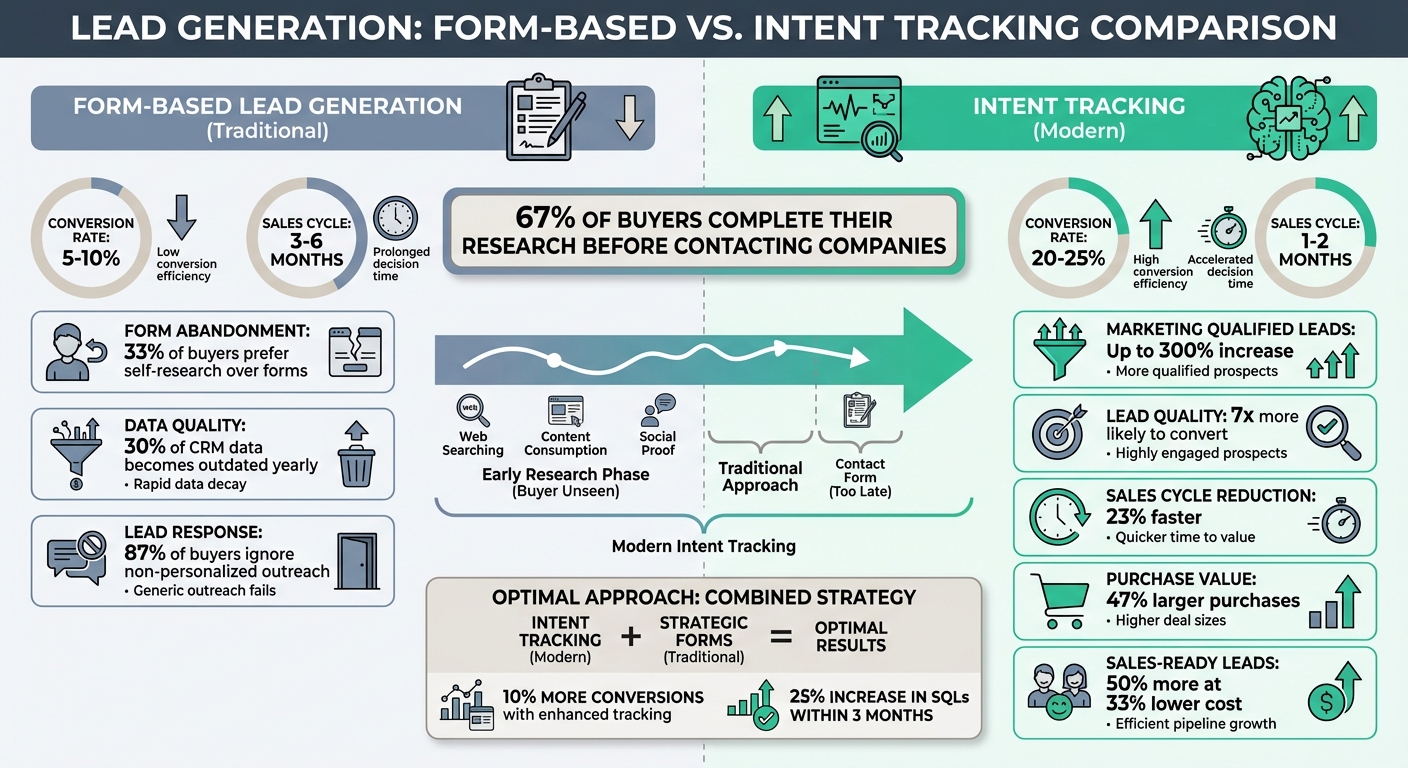
Intent Tracking vs Form-Based Lead Generation Performance Comparison
Buyer intent: How to leverage intent signals for B2B outreach success
Problems with Form-Based Lead Generation
Traditional form-based methods often fall short when it comes to capturing genuine buyer intent. These forms create a bottleneck in lead generation by requiring users to manually input their information. This extra step introduces friction, leading to missed opportunities - especially when 33% of buyers would rather conduct their own research than fill out a form and risk being contacted by sales teams they’re not ready to engage with.
High Form Abandonment Rates
The more fields a form has, the higher the chances of abandonment. This forces marketers to choose between keeping forms short or collecting more detailed data. Even with minimal fields, forms only capture information from a small percentage of website visitors, leaving many high-intent prospects unidentified. On top of that, 87% of buyers ignore outreach that isn’t tailored to their specific needs. This makes it incredibly difficult to craft personalized follow-ups, further limiting the effectiveness of traditional forms.
Missing Behavioral Data
Forms only collect what users willingly share, leaving out critical insights that behavioral data could provide. For instance, they don’t track which pages visitors explore, how they navigate your site, or if they engage with content that signals purchase intent. Without this context, a significant portion of your potential leads remains hidden in what’s often referred to as the "dark funnel."
Manual Lead Qualification Drains Resources
Without behavioral insights, all leads look the same on paper, forcing sales teams to spend unnecessary time manually qualifying them. This inefficiency is compounded by the fact that intent data can pinpoint leads that are seven times more likely to convert, while 30% of CRM data becomes outdated every year. The result? Wasted time and resources that could be better spent on engaging high-potential prospects.
How Intent Tracking Works
Intent tracking offers a modern alternative to traditional form-based lead generation. Instead of relying on prospects to fill out forms, it observes their digital behavior to identify who’s actively researching a purchase. By analyzing these digital breadcrumbs, intent tracking helps pinpoint which potential customers are seriously considering a solution and which ones are just browsing. This method overcomes the limitations of form-based systems by focusing on actions that reveal high-value prospects.
The process starts by gathering behavioral data from various digital sources. Tracking scripts and session monitoring tools capture key activities like page visits, time spent on pages, downloads, and navigation patterns. AI algorithms then assess this data, assigning engagement scores to leads based on how actively they interact online.
What sets intent tracking apart is its ability to identify prospects early in their journey. Studies show that buyers are often 67% through their decision-making process before reaching out to a company. By the time they fill out a form, they’ve already done extensive research. Intent tracking allows businesses to engage with these prospects while they’re still exploring, giving them a head start over traditional methods. This approach lays the groundwork for understanding the signals that indicate genuine buying intent.
What Are Intent Signals?
Intent signals are specific user actions that reveal a clear interest in purchasing. These behaviors indicate that a prospect is actively evaluating options. For example, visiting a pricing page, downloading a whitepaper, or searching for product-specific information are all strong indicators of intent.
Intent signals can be grouped into two categories:
- Active intent: Direct actions such as requesting demos, attending webinars, or using ROI calculators.
- Passive intent: Indirect indicators like recent funding rounds, leadership changes, or office expansions, which suggest a company may be gearing up for new purchases.
Here’s a breakdown of common intent signals and what they reveal:
| Intent Signal Category | Specific User Actions | What It Indicates |
|---|---|---|
| Website Behavior | Pricing page visits, product comparisons, demo requests | Strong purchase intent; active evaluation |
| Content Consumption | Downloading whitepapers, using ROI calculators, reading guides | In-depth research; interest in solution details |
| Search Intent | Keywords like "[Competitor] alternatives" or "best [Category]" | Active buying phase; comparing solutions |
| Engagement | Attending webinars, watching demos, interacting with chatbots | Ready for a sales conversation |
| Firmographics | Recent funding, leadership hires, office expansions | Likely timing for new investments |
Not all signals carry the same weight. For example, spending several minutes on a pricing page after reviewing case studies shows stronger intent than quickly leaving the homepage. By analyzing the combination and sequence of actions, businesses can get a clearer picture of a prospect’s intent.
Collecting Real-Time Behavioral Data
Intent tracking tools gather data from three main sources: first-party data from owned websites and CRMs, second-party data from partner platforms like G2, and third-party data from publisher networks and social media.
First-party data is the most reliable because it’s directly collected. When someone visits your website, tracking scripts capture their page views, clicks, scrolls, and interactions. Tools like MagicTag even track real-time input, such as partially completed forms, to identify prospects who showed interest but didn’t fully convert.
Jennifer Peters, Director of DTC, Martech, and Digital Compliance at OLLY, used Contentsquare to analyze real-time customer behavior and remove friction in the buying process. This approach led to a 20% increase in website revenue month-over-month and a 3% rise in average order value. As Peters explained:
"Customers vote with their wallet. They vote with their behavior, and you have to be able to react to that quickly and not put your own preferences and bias ahead of what the customers are actually telling you."
The shift to first-party data has gained momentum due to privacy regulations like GDPR and CCPA. With third-party cookies becoming less effective, companies are prioritizing direct interactions, making first-party behavioral data more essential than ever.
Once collected, this data is processed by AI systems to generate actionable lead scores.
Using AI to Score and Prioritize Leads
AI transforms raw behavioral data into actionable insights. Machine learning algorithms analyze thousands of data points to uncover patterns that differentiate successful conversions from unqualified leads. Predictive models evaluate past behaviors to identify which actions are most closely linked to purchasing decisions.
These systems work in real time, assigning scores to leads based on their engagement. For instance, if a prospect from a high-value account repeatedly visits your pricing page, downloads case studies, and attends a webinar, the AI flags them as a high-priority lead. The algorithms are self-improving, continuously refining their scoring models as new data comes in.
The impact is clear. Recent statistics show that 66% of sales professionals believe AI helps them deliver personalized experiences and better understand their customers. AI tools can also automatically route high-scoring leads to the most suitable sales reps, ensuring quick follow-up with prospects showing strong buying intent. This efficiency is vital in today’s market, where 53% of salespeople say selling has become more challenging.
Modern AI scoring systems go beyond simple calculations. They use negative scoring to weed out low-quality leads, such as deducting points for generic email addresses or incorrect contact details. The most advanced systems create two separate scores: one for "fit" (based on demographics and firmographics) and another for "interest" (based on behavioral intent). This dual scoring approach helps teams focus on the leads most likely to convert.
Why Intent Tracking Beats Forms
Intent tracking offers measurable outcomes that forms simply can't match. While forms depend on prospects taking the first step, intent tracking identifies buyers who are actively researching solutions in real time. This shift makes a noticeable impact in three key areas: conversion rates, sales cycle speed, and marketing ROI. By proactively identifying potential customers, businesses can boost conversions, shorten sales timelines, and achieve better returns on their marketing investments.
Better Conversion Rates
Intent tracking engages prospects earlier in their decision-making process - right when they’re evaluating options and ready to act. By this point, they’ve already done much of the heavy lifting in terms of research.
Advertisers who use enhanced conversion tracking powered by first-party intent data see an average of 10% more conversions compared to those sticking with standard offline methods. Timing is critical here: conversions are highest when the action occurs within seven days of the initial ad interaction.
"Access to quality purchase intent data helps sales and marketing teams not only prioritize warmer leads but also reach them with the right content at the right time." - Rupal Bhandari from Gartner
Faster Sales Cycles
Intent tracking speeds up the sales process by removing the delays typical of form-based methods. Traditional approaches rely on prospects to reach out, often dragging out the time between initial interest and first contact. Intent tracking flips the script by letting businesses act immediately when behavioral signals indicate interest.
Companies leveraging behavioral intent data can reduce sales cycles by 23%. This approach also delivers 50% more sales-ready leads at 33% lower costs. Timing remains crucial: responding to a lead within five minutes makes a connection 100 times more likely, and conversion rates jump by 391% when that response happens in under a minute.
"The real power of B2B intent data lies in its ability to separate serious buyers from casual browsers. It's like having the secret passages in Clue - moving directly to where the action is while others waste time checking empty rooms." - Jeremy Payton from Zapier
With intent tracking, sales teams can skip generic discovery calls and instead focus on delivering tailored, relevant solutions based on what prospects are already researching.
Better Return on Marketing Spend
Intent tracking maximizes marketing ROI by focusing efforts on prospects who are ready to buy. Traditional campaigns often prioritize generating a high volume of leads, but this can result in wasted resources on unqualified prospects. Intent tracking shifts the focus to behavioral signals that strongly align with revenue opportunities.
Leads identified through intent signals tend to make purchases that are 47% larger. Additionally, intent-based strategies can recover up to 30% of lost revenue by responding to live signals like cart abandonment or visits to high-value pages.
By targeting niche, high-intent segments, businesses can see a 25% increase in Sales Qualified Leads (SQLs) within just three months. Automated intent scoring further streamlines the lead qualification process, reducing manual effort, lowering acquisition costs, and increasing overall pipeline value.
"In business, to waste time is to waste money, so you need a strategy that is efficient and the best use of your resources." - Erica Santiago from HubSpot
Intent tracking helps businesses prioritize the prospects that need immediate attention while nurturing others over time. This proactive approach transforms marketing from a reactive form-based system into a dynamic, intent-driven engine - delivering more results with fewer wasted resources.
sbb-itb-77d5bc3
Combining Intent Tracking with Forms
Merging intent tracking with forms creates a powerful duo: intent signals highlight interest, while forms gather critical details, giving you a full picture of each prospect. This combination uses the speed and accuracy of intent data to enhance direct lead capture.
By building on the advantages of intent tracking, strategically adding forms sharpens your lead-generation efforts.
Place Forms on High-Intent Pages
Not every page on your site needs a form. Pages like pricing, demo requests, and product comparisons are where buying interest is at its peak. These are the ideal spots for forms because visitors on these pages are actively evaluating your solution.
To maximize effectiveness, place forms above the fold on high-intent pages. This positioning encourages immediate action. Adam Lange, CEO of Signpost, explains:
"The form is positioned at the top of the page, above the fold, which makes the action we want the user to take clear from the outset".
This approach works because visitors on these pages are already seeking more information. Your job is to make it easy for them to take the next step.
Optimize Form Fields with Progressive Profiling
Long forms can scare off potential leads. Instead of overwhelming visitors upfront, use progressive profiling to gather details gradually as prospects interact more with your content. Start with the basics - like name and email - and ask for additional details, such as company size or job role, during later visits.
This step-by-step approach minimizes the initial friction of filling out a lengthy form. You can also use lead enrichment tools to automatically pull in firmographic data - such as company size or industry - based on IP address or email domain. This keeps your forms short while still capturing valuable details for your CRM. As Josh Grossman points out, shorter forms tend to convert better, so only ask for what’s absolutely necessary.
Once you’ve streamlined your forms, enhance the value of each lead by adding behavioral insights.
Add Behavioral Context to Form Data
Forms capture contact details, but intent tracking uncovers buying signals. For example, when a prospect submits a form after visiting key pages - like competitor comparisons or enterprise features - their browsing behavior provides critical context that can simplify lead qualification.
Integrate this browsing history into your CRM so sales reps can skip generic questions and jump into meaningful conversations. Set up real-time alerts to notify your team when high-value accounts display intent signals, such as multiple visits to a pricing page followed by a form submission. Responding quickly is crucial: companies that follow up within five minutes are 100 times more likely to connect with a lead compared to waiting an hour. Conversion rates soar by 391% when the response time is under one minute.
Additionally, tools like MagicTag can capture real-time user data as visitors type into form fields - even if they abandon the form before submitting. This data integrates with your CRM via webhook or API, ensuring no potential lead slips through the cracks. By combining intent signals with form data, you can create dynamic prospect profiles that empower your sales team to act decisively.
Privacy and Compliance in Intent Tracking
Intent tracking provides valuable insights but also comes with serious legal responsibilities. Mishandling data can lead to hefty fines - up to 4% of global revenue or €20 million under GDPR, and $2,500–$7,500 per violation under CCPA. Beyond the financial penalties, it can erode customer trust and tarnish your brand. However, when done correctly, intent tracking can balance compliance with effectiveness. Let’s look at how cookieless tracking and first-party data can protect privacy while boosting revenue.
Cookieless Tracking and First-Party Data
With the gradual disappearance of third-party cookies, businesses are turning to first-party data - information gathered directly from user interactions on your website, like form submissions, account logins, or browsing activity. This data is not only accurate but also collected with user consent.
Cookieless tracking leverages deterministic identifiers, such as email addresses or loyalty program IDs, to link user behavior to specific individuals without relying on third-party cookies. For instance, when a visitor provides their email in a form, you can associate their browsing history - like visits to pricing or product pages - with that email. This method maintains tracking precision while respecting user privacy.
The integration of first-party data can yield remarkable results. Businesses that embrace these strategies often double the incremental revenue from a single ad placement compared to those with limited data integration. Take the example of Thai property developer Sansiri. In December 2023, they enhanced their Google Ads campaigns by syncing Salesforce CRM data using hashed first-party data. The outcome? A 43% increase in qualified leads and a 48% drop in cost per acquisition. Artitaya Pansuwan, iProspect Planning Director, commented:
"With enhanced conversions for leads, we could get better insights for optimizing Sansiri's Search campaigns toward high-quality leads, consistently, and at scale".
Meeting GDPR and LGPD Requirements
The GDPR applies to any organization handling the personal data of EU residents, no matter where the company is based. It requires a clear legal basis for data processing - usually explicit consent - and mandates that consent be informed, specific, unambiguous, and revocable. Brazil’s LGPD follows similar guidelines.
Both regulations grant individuals rights such as knowing what data is collected about them, requesting data deletion (the "right to be forgotten"), and opting out of data sales. Organizations must also implement strong security measures, like encryption, and report breaches to authorities within 72 hours.
Data minimization is key: only collect what’s necessary for your stated purpose. Consent requests should be clear and straightforward. To ensure compliance, consolidate all intent signals in your CRM for a unified and secure view of the customer journey.
Using Privacy-Compliant Tools Like MagicTag
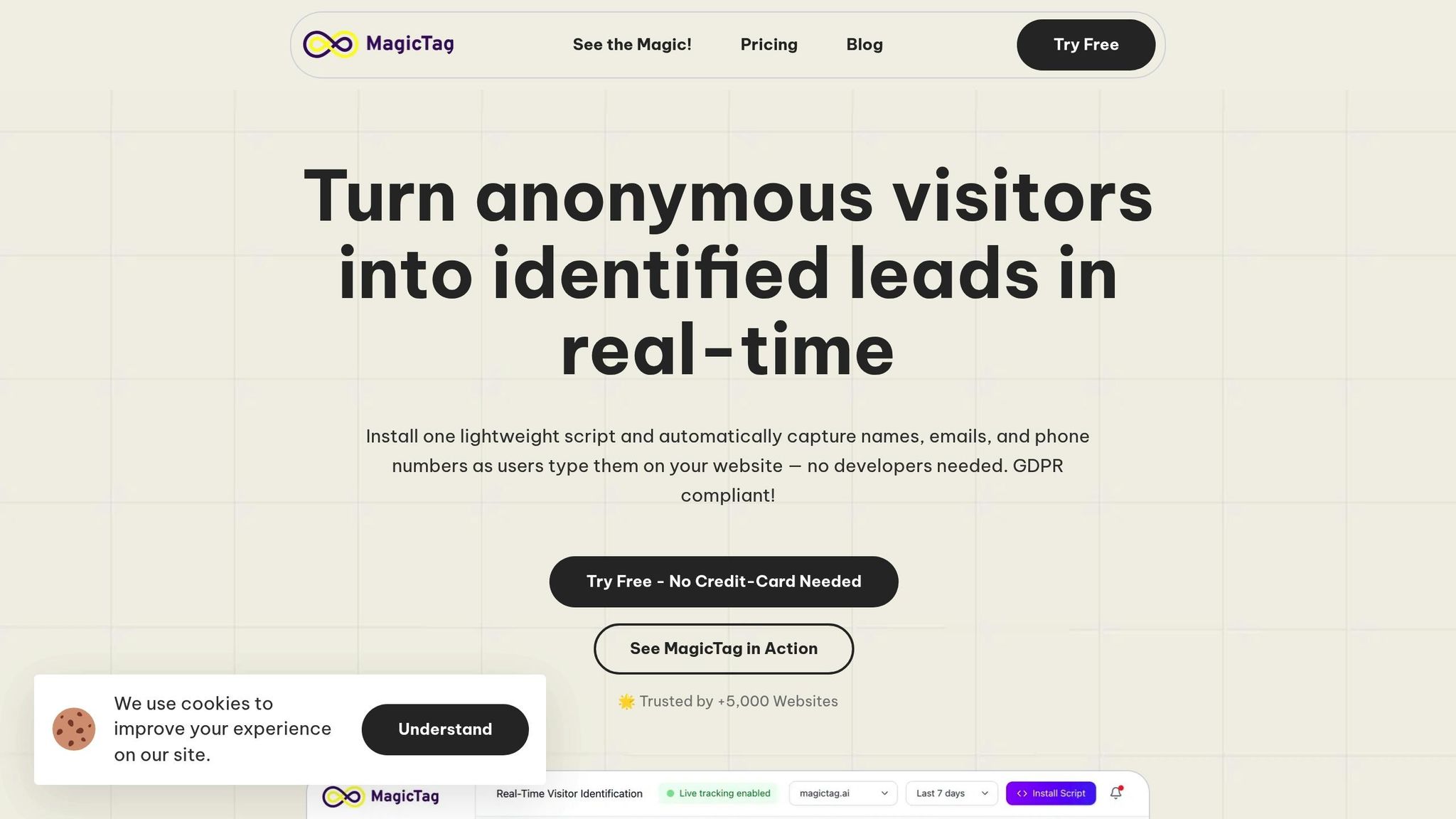
MagicTag is a tool that captures real-time data as users type - even if they abandon the form - while staying compliant with GDPR and LGPD. By focusing on first-party data collection methods, MagicTag ensures that all information is gathered with proper consent.
The data flows securely into your CRM via webhook or API, enriching lead profiles without sacrificing privacy. MagicTag also supports hashed data matching, safeguarding user identities while connecting online behaviors to offline outcomes. This approach was successfully adopted by Hong Kong’s WeLend, which saw a 12% boost in conversion rates and a 17% increase in conversion value through first-party data integration. Marco Lee, General Manager at WeLend, shared:
"The impact of this innovative solution has been phenomenal. We believe it will be a game-changer for performance marketing and our business as a whole".
Measuring and Improving Intent Tracking Programs
Getting an intent tracking program up and running is just the start. The real payoff comes from tracking results and tweaking your approach. Once intent tracking becomes part of your lead recovery strategy, keeping an eye on key metrics is essential. Without clear data, you can’t fine-tune your efforts or maximize your investment.
Key Metrics to Track
Start by watching conversion rates at every stage of the funnel. Follow how leads move from showing intent to becoming closed deals. Businesses using a demand-to-revenue model report a 35% higher conversion rate compared to those without structured tracking.
Metrics like Cost Per Lead (CPL) and Customer Acquisition Cost (CAC) help you assess how efficiently you’re spending. Pair these with Sales Cycle Duration to measure how quickly high-intent leads progress through your pipeline. Companies that excel at nurturing leads generate 50% more sales-ready leads while cutting costs by 33%.
Lead quality is another critical factor. Adjust intent thresholds (cold <30, warm 30–70, hot >70) based on actual performance. For instance, a FinTech company that adopted an ABM 2.0 strategy with intent data in 2025 saw a 3× increase in Sales Qualified Opportunities and added $4.1 million to its pipeline in just 120 days. Tracking metrics like pipeline value and ROI ensures you can justify the program’s budget and demonstrate its impact on revenue.
| Metric Category | Key Performance Indicators | Purpose |
|---|---|---|
| Efficiency | CPL, Customer Acquisition Cost (CAC) | Assess spending effectiveness |
| Velocity | Sales Cycle Duration, Lead Pickup Rate | Track funnel speed |
| Quality | MQL to SQL Conversion Rate, Lead Quality Score | Validate intent signal accuracy |
| Volume | Pipeline Value ($), Total Leads Generated | Measure program reach |
| Profitability | ROI, Average Lead Value | Gauge bottom-line impact |
These metrics not only highlight the value of intent data but also provide a roadmap for refining your program over time.
A/B Testing for Optimization
Once you’ve established your metrics, use A/B testing to fine-tune your strategies. Test one variable at a time. For example, experiment with the number of form fields, tweak your call-to-action wording, or adjust page layouts to reduce friction. You can also test behavioral triggers - should a visit to your pricing page prompt immediate outreach, or is a nurture sequence more effective?
Timing is another area to explore. Test different follow-up intervals for various intent signals to find what drives the most engagement.
Progressive profiling - collecting data in small steps as prospects engage - can help you balance the need for qualification with the risk of losing leads to form abandonment. Personalization is another powerful tool. Try tailoring email content or website messaging based on specific behaviors, and see which approaches resonate most with high-intent visitors.
Building a Continuous Improvement Process
Create a feedback loop that connects sales outcomes with your marketing systems. This allows you to refine scoring models and adjust campaign spending based on what actually converts.
Hold monthly experiments and quarterly pipeline reviews with your sales team to ensure lead quality stays on track. One company, for example, implemented a centralized lead management system in 2025. By creating customized pipelines and shared timelines, managers could flag stalled leads and adjust messaging based on real engagement data. As one Relationship Manager put it:
"When somebody logs in to their dashboard and can quickly see everything they need to get done that day… it makes a difference."
Take advantage of AI to uncover patterns you might miss - like certain combinations of page views and company sizes that predict higher conversion rates.
Finally, don’t overlook data hygiene. About 30% of CRM data becomes outdated every year. Regularly clean your database to remove duplicates and outdated records, ensuring your A/B tests and scoring adjustments are based on reliable information. By committing to continuous improvement, your intent tracking program will stay aligned with your broader lead generation strategies.
Conclusion
The move from traditional lead generation methods to intent tracking marks a major leap forward in identifying and converting potential customers. While traditional forms often miss out on high-intent leads, intent tracking focuses on key behavioral signals - like visits to pricing pages, time spent on-site, and scroll activity - to pinpoint prospects who are ready to buy, even before they provide their details.
AI-driven lead scoring can boost conversion rates by 25%, and businesses using these strategies report up to 50% more sales-ready leads. Additionally, marketing automation powered by AI has been shown to generate an impressive 451% more leads compared to manual campaigns. Considering that 78% of buyers choose the first vendor to respond, speed is critical for turning interest into action.
"The future belongs to businesses that stop chasing leads and start anticipating them." - AgentiveAIQ
To make the most of these insights, leverage intent tracking to identify visitors exhibiting strong buying signals. Place forms strategically on high-intent pages and use progressive profiling to reduce friction. Tools like MagicTag can even capture real-time input from abandoned forms, enabling your CRM to automatically send personalized follow-ups when prospects revisit key pages or download resources - all while staying compliant with GDPR and LGPD regulations.
FAQs
How does intent tracking help boost lead conversion rates compared to traditional forms?
Intent tracking takes lead conversion to the next level by focusing on real-time behavioral signals instead of waiting for prospects to fill out a form. This proactive strategy helps businesses zero in on high-intent prospects - those who are more likely to take action - boosting the chances of conversion.
With tools like AI-powered analytics and behavioral insights, intent tracking not only speeds up the sales process but also delivers better results. Unlike traditional methods that depend on user submissions and often overlook key engagement moments, intent tracking gathers crucial data throughout the entire customer journey, ensuring no opportunity is missed.
What are the key signs that a prospect is ready to make a purchase?
When a potential customer is gearing up to make a purchase, their actions often speak louder than words. They might visit key pages on your site multiple times - think pricing details, product features, or comparison charts. Actions like requesting a demo or downloading specific resources are also strong giveaways. Even their email engagement, such as consistently opening emails or clicking on links tied to your product, can signal growing interest.
You might also notice patterns like several team members from the same company checking out your site or early conversations about budget. When these behaviors stack up - frequent visits, resource downloads, and demo requests - it’s a clear sign they’re shifting from just exploring to being ready to commit.
How can businesses use intent tracking while staying privacy compliant?
To ensure privacy compliance when tracking user intent, businesses should handle collected data as first-party data - data sourced directly from their own platforms, such as website visits, email engagement, or content downloads. It's essential to secure explicit user consent through clear opt-in forms or privacy notices. Additionally, data should be tied to anonymized identifiers rather than linked to personal profiles.
Taking a privacy-by-design approach is crucial. This means implementing measures like publishing a clear and transparent privacy policy, using consent management tools to respect user preferences, retaining data only for as long as necessary, and routinely auditing and securely deleting data that lacks valid consent. Staying aligned with regulations like the CCPA and GDPR helps ensure ethical use of intent data while safeguarding user privacy.
By prioritizing explicit consent, anonymizing data, and conducting regular compliance checks, businesses can leverage intent tracking responsibly without compromising user trust.