Shoppers abandon about 70% of online carts, leading to $18 billion in annual losses for e-commerce businesses. The good news? 75% of these shoppers plan to buy later, with 72% intending to purchase within 48 hours. By understanding why they leave - whether due to high shipping costs, distractions, or account creation requirements - businesses can recover lost sales effectively.
Here’s the key: predicting user intent. High-intent shoppers convert at 77%, compared to 63% for casual browsers. Tools like MagicTag use real-time behavior tracking and predictive scoring to identify high-intent users, address their concerns, and recover carts efficiently. Personalized strategies - like offering free shipping to price-sensitive users - can boost conversions without unnecessary discounts, protecting profits.
Quick Wins:
- Focus on intent: Tailor recovery efforts to high-intent shoppers.
- Act fast: Send recovery emails within 30-60 minutes of abandonment.
- Leverage tools: MagicTag captures user details in real time, even for anonymous visitors, enabling smarter follow-ups.
Recovering even 10% of abandoned carts can increase monthly revenue by 23%. Don’t let these opportunities slip away - prioritize intent-driven recovery.
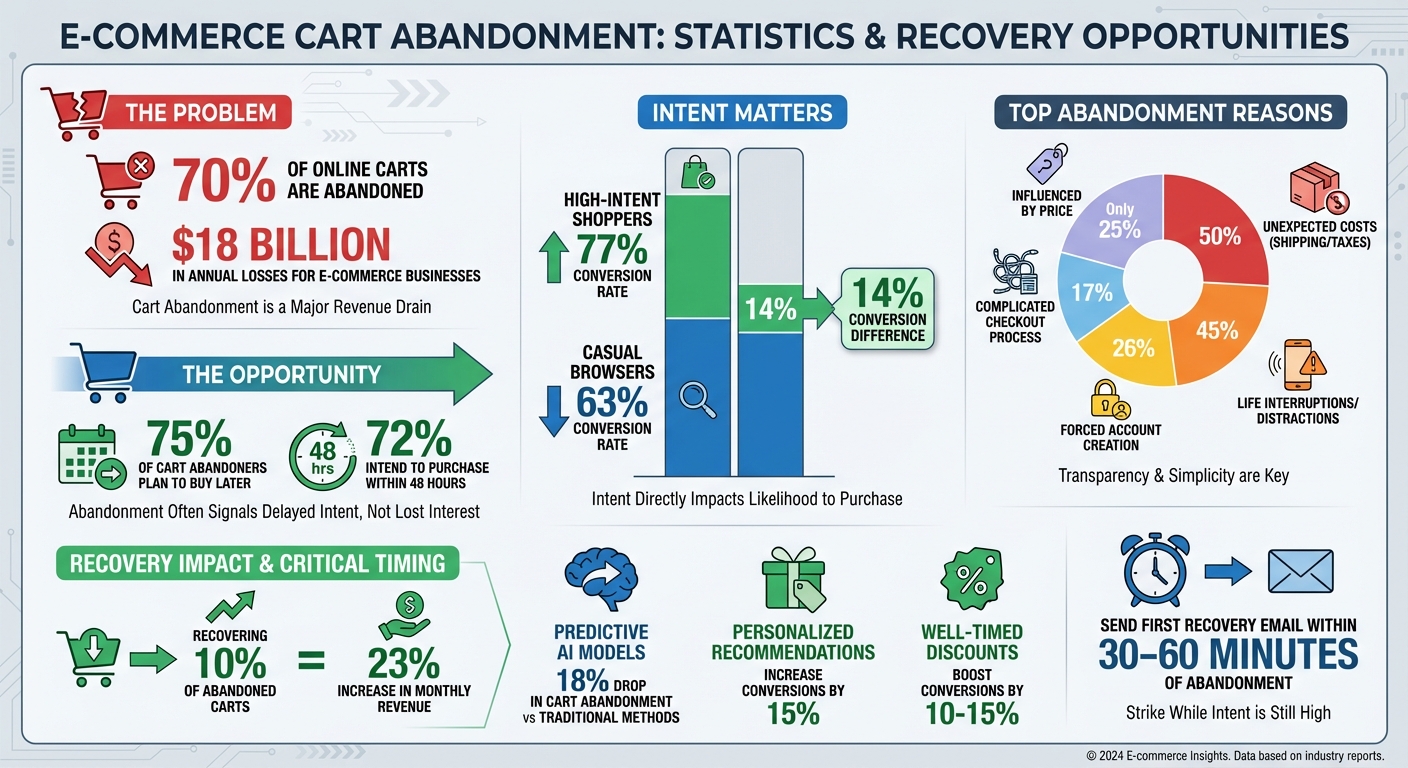
Cart Abandonment Statistics and Recovery Impact for E-commerce
Ultimate Guide To Cart Abandonment Recovery - Easiest Way To Boost Revenue
Why Traditional Cart Recovery Methods Fall Short
Many businesses stick to a familiar routine: they send out a generic "You left something behind" email a day after a cart is abandoned, often sweetened with a 10% discount code. While this approach might seem practical, it treats every shopper the same - whether they're ready to buy or just casually browsing.
The Problem with One-Size-Fits-All Approaches
The trouble with this approach is that it ignores the diverse reasons people abandon their carts. For instance, 50% of shoppers leave because of unexpected costs like shipping or taxes, while 45% abandon their carts due to life interruptions. Another 24% quit when asked to create an account, and 17% give up because the checkout process is too complicated. A blanket discount doesn’t solve these specific issues - it just eats into profits.
"Picture walking out of a clothing store, and instead of asking what went wrong... the staff just throws a 10% voucher at everyone heading for the door. Helpful? Sometimes. Relevant? Rarely." – Harald Neuner, Co-founder, uptain
Interestingly, only 25% of cart abandonments are influenced by price. This means that for three out of four shoppers, a discount isn’t the solution to their hesitation. High-intent buyers who were already ready to purchase end up getting unnecessary discounts, while casual browsers simply ignore the message. On top of that, overuse of repetitive popups contributes to "banner blindness", making these tactics even less effective.
Here’s a telling stat: businesses using predictive AI models see an 18% drop in cart abandonment compared to those sticking with traditional recovery methods. Clearly, it’s time to rethink outdated strategies. But before diving into solutions, there’s another major obstacle to address - anonymous users.
The Challenge of Anonymous Users
Traditional recovery methods like email and SMS rely on having the shopper’s contact information. But here’s the rub: most cart abandoners are anonymous users who never provide an email or create an account. And when businesses try to force registration, it backfires - mandatory account creation is responsible for 26% of all cart abandonments. It’s a frustrating cycle: you need their info to recover the sale, but asking for it drives them away.
To make matters worse, privacy updates from Apple and Google have weakened traditional tracking tools, leading to "signal loss" and making it harder to identify site visitors. Without knowing who these shoppers are, businesses can’t personalize their outreach, time their follow-ups, or address specific concerns like pricing, trust, or return policies.
These challenges underscore the need for a smarter, more tailored approach. Real-time data capture and predictive tools now offer a way to bridge the gap, helping businesses recover lost revenue more effectively.
How Lead Intent Prediction Works
Lead intent prediction focuses on analyzing shoppers' real-time behavior to anticipate their actions before they leave your site. Instead of waiting to react after cart abandonment, this method uses machine learning to forecast which visitors are likely to complete a purchase and which ones might leave. By doing so, it creates a framework for understanding and quantifying intent.
What Lead Intent Prediction Means
At its core, lead intent prediction assigns a real-time "intent score" to each visitor. As users navigate your site, the system monitors behavioral cues like time spent on the checkout page, hovering over shipping details, or repeatedly viewing the same product. These small actions, known as micro-signals, form the basis of the intent score.
For example, hovering over a shipping link for 8 seconds becomes a key variable in predicting intent. The system then calculates the likelihood of a visitor completing their purchase or abandoning their cart. High-intent users often exhibit behaviors like comparing prices, reading reviews, or adding items to wishlists - indicators that suggest up to an 80% chance of conversion. On the other hand, low-intent users might use the cart as a placeholder or browse aimlessly without progressing to checkout.
What's fascinating is how the intent score evolves in real time. If a casual browser suddenly reads reviews or checks the return policy, their score can shift dramatically, signaling a higher likelihood of conversion. This allows businesses to adapt engagement strategies based on the visitor's latest actions.
"We're talking about predicting behavior, not reacting to it. And that changes everything." – Vivian, MetricsCart
Unlike broad, one-size-fits-all recovery tactics, this approach uses real-time data to deliver precise interventions, addressing specific user challenges as they arise.
The Advantages of Predicting User Intent
Predicting intent offers a more tailored approach to customer engagement. Instead of giving blanket discounts to everyone, you can personalize offers based on where a shopper is in their buying journey. For instance, high-intent users - who already have a 77% likelihood of converting - can enjoy a streamlined checkout process with minimal friction. Meanwhile, low-intent users might receive nudges like social proof or small discounts to encourage them to act.
This level of precision drives better results. Personalized product recommendations alone can increase conversions by up to 15%, while well-timed discounts can boost conversions by 10% to 15%. Even better, it prevents unnecessary discounting for customers who were ready to pay full price, protecting your profit margins.
Intent prediction also allows you to address specific shopper concerns. If someone hesitates over shipping costs, offering free shipping can seal the deal. If the checkout process seems confusing, a live chat prompt can guide them through. By solving the right problem at the right time, you're much more likely to turn hesitant browsers into paying customers.
sbb-itb-77d5bc3
Using MagicTag for Cart Abandonment Recovery
MagicTag takes the guesswork out of cart abandonment recovery by combining intent prediction with real-time data capture. While predicting intent helps identify who might abandon their cart, MagicTag steps in to secure critical contact details, ensuring you can re-engage potential customers before they leave.
Real-Time Data Capture Before Form Submission
MagicTag works in real time, capturing visitor details as they begin typing into form fields - whether it’s a name, email, or phone number. For instance, as soon as a visitor enters their email, that information is saved. This approach can collect up to 12x more leads compared to relying solely on completed form submissions. Even better, MagicTag offers a free plan that supports up to 1,000 identified users per month, making it accessible for smaller e-commerce businesses looking to recover lost revenue.
API and Webhook Integrations
To make the most of the captured data, MagicTag ensures seamless integration with your CRM or marketing tools, enabling swift recovery actions. It connects effortlessly with platforms like Klaviyo, HubSpot, and Customer.io using APIs and webhooks. Here’s how it works:
- Install the MagicTag tracking pixel - no coding skills required.
- Set up a URL trigger on your cart or checkout page to detect high-intent users.
- When MagicTag captures an email, it sends the data directly to your CRM, adding the lead to your abandoned cart audience.
- Your CRM then kicks off a recovery sequence, whether through email, SMS, or retargeting ads.
Timing is everything. Since 45% of carts are abandoned due to distractions, sending the first recovery email within 30 to 60 minutes can significantly improve your chances of converting a lost sale.
Applying Intent Prediction in Practice
Once the data is seamlessly fed into your CRM, you can refine your recovery strategies based on user behavior. MagicTag’s strength lies in pairing real-time data capture with intent-based segmentation. Not every cart abandoner needs the same follow-up. For example, a visitor who spends time comparing shipping options is likely more engaged than someone who just skims through your site.
Conclusion: Recovering Revenue with Intent Prediction
Key Takeaways
Predicting shopper intent turns cart abandonment from a frustrating revenue loss into a chance for strategic recovery. Research shows that shoppers with high purchase intent are far more likely to convert compared to casual browsers. By analyzing real-time behavioral cues, you can pinpoint hesitation triggers and respond with tailored interventions at just the right time.
Switching from generic recovery emails to personalized, intent-driven strategies not only boosts conversions but also protects your profit margins. Blanket discounts may encourage customers to abandon carts in hopes of future deals, but predictive tools help identify who genuinely needs a price incentive and who might just need clarity on things like shipping policies. This fine-tuned approach can cut unnecessary discount costs by as much as 25% while maintaining conversion rates. By addressing specific shopper concerns, you create a recovery process that feels thoughtful and effective.
Getting Started with MagicTag
Once you’ve embraced intent prediction strategies, it’s time to put them into action with the right tool. MagicTag’s real-time data capture identifies anonymous users as they interact with your site, helping recover up to 12x more leads. Its free plan supports up to 1,000 identified users each month, making it a scalable solution for businesses of all sizes.
Here’s how to get started: Install the MagicTag tracking pixel on your cart and checkout pages, then link it to your CRM using webhooks or an API. Configure URL triggers to detect high-intent behaviors, and let your automated recovery sequences handle the rest. Timing is crucial - send your first recovery message within 30 to 60 minutes to maximize your chances of turning abandoned carts into completed sales, all while preserving your profit margins.
FAQs
How does predicting lead intent help recover abandoned carts?
Predicting lead intent plays a key role in recovering abandoned carts by pinpointing shoppers who are most likely to follow through with their purchase. With this insight, businesses can engage these high-intent visitors using customized approaches like exclusive discounts, tailored product suggestions, or proactive live chat assistance.
Targeting these users allows businesses to nudge them toward completing their checkout, boosting recovery rates and driving revenue growth. Tools such as MagicTag make this process even smoother by capturing real-time user data - even if the form remains incomplete - making it easier to reconnect with potential customers.
How does MagicTag help capture user data for abandoned cart recovery?
MagicTag helps tackle the challenge of abandoned carts by capturing user information - like name, email, and phone number - in real time as users fill out form fields, even if they don’t hit “submit.” This means businesses can identify and reconnect with potential customers who might have otherwise slipped away unnoticed.
Thanks to its smooth integration with CRMs through webhooks or APIs, MagicTag makes it easy to recover leads, refine remarketing strategies, and increase conversions. It’s simple to set up, compatible with any website, and adheres to GDPR and LGPD guidelines, making it an effective solution for boosting lead identification and customer engagement.
Why are personalized strategies better than offering blanket discounts for recovering abandoned carts?
Personalized strategies outperform blanket discounts because they cater to each shopper's specific needs and motivations. Blanket discounts, on the other hand, treat all customers the same, often overlooking key reasons for cart abandonment - like price sensitivity, high shipping costs, or insufficient product details. This one-size-fits-all approach can result in missed opportunities and unnecessary profit losses.
With AI-driven personalization, businesses can pinpoint individual barriers and provide tailored solutions. For example, they might offer a free shipping code to address high shipping costs or suggest a complementary product to complete a bundle. This ensures discounts are only applied when truly necessary, helping to maintain healthier profit margins.
Pairing this approach with tools like MagicTag takes it a step further. MagicTag captures real-time user data - such as name, email, phone number, and browsing behavior - as it’s entered. This allows businesses to segment users with precision and engage high-intent shoppers with personalized offers before they leave, significantly boosting cart recovery rates.