98% of website visitors leave without filling out forms. This means most of your traffic remains invisible to your sales team, leaving potential leads untapped. But you can change that by identifying anonymous visitors using methods like IP-based company identification, cookie data, and intent scoring. These techniques allow you to transform anonymous traffic into actionable leads while respecting privacy laws like GDPR and CCPA.
Key Takeaways:
- IP Tracking: Identify companies visiting your site via reverse IP lookups.
- First-Party Cookies: Track visitor behavior across sessions to build profiles.
- Intent Scoring: Prioritize leads based on engagement signals like repeated visits to key pages.
- MagicTag: Recover incomplete form submissions by capturing input data in real time.
By combining these approaches, you can align sales and marketing efforts, boost conversion rates, and recover lost opportunities - all while staying compliant with privacy regulations.
How to Identify Your Anonymous Website Visitors and Boost Your Sales
Methods for Identifying Anonymous Website Visitors
Discovering the identities of anonymous website visitors can be done through several effective techniques, all while adhering to privacy regulations.
IP-Based Company Identification
Every time someone visits your website, their IP address is recorded. By performing a reverse IP lookup, you can match that address to databases containing known corporate networks. This process allows you to identify the organization behind the visit. Once identified, you can enrich this data with details like the company’s industry, employee count, annual revenue, or even recent funding activity.
However, this method has its limitations. Traditional IP tracking captures only about 30% of traffic because remote workers, VPN users, and mobile visitors often connect through residential ISPs instead of corporate networks. Additionally, privacy laws like GDPR classify IP addresses as personal data, requiring explicit consent. Similarly, CCPA and CPRA mandate clear disclosures and the option to opt out.
To maximize accuracy, exclude internal traffic from your own team, agencies, or partners before analyzing the data. Syncing identified companies with your CRM in real time allows your sales team to act quickly. Combining IP data with behavioral signals - such as multiple visits to your pricing page - can help prioritize leads showing strong buying intent. From here, cookie data and visitor IDs can further refine your understanding of these visitors.
Cookie Data and Visitor IDs
First-party cookies provide a detailed view of visitor behavior on your site, tracking actions like pages viewed, time spent, and return visits. When a visitor eventually fills out a form or clicks a specific link, visitor IDs connect their previous anonymous activity to their profile.
As third-party cookies are being phased out by major web browsers, first-party cookies - set directly by your domain - are becoming increasingly essential for tracking. Another method, browser fingerprinting, analyzes device attributes such as screen resolution, operating system, and installed fonts to create persistent visitor IDs. This approach works even if cookies are cleared.
To ensure smooth performance, use compact tracking scripts that won’t slow down your site. Additionally, progressive profiling allows you to collect more information over time without overwhelming visitors. Once you’ve built these behavioral profiles, you can take things a step further by applying behavioral and intent scoring to quantify engagement.
Behavioral and Intent Scoring
Not all visitor actions are created equal. For example, downloading a case study signals far stronger interest than casually skimming a blog post. Intent scoring uses artificial intelligence to analyze micro-actions - like clicks, scrolls, and session duration - and assigns a score indicating the likelihood of conversion.
These scores update in real time as visitors continue interacting with your site. This dynamic scoring helps you differentiate between casual browsers and decision-makers who are closer to making a purchase. Automated workflows can be set up to take action when a visitor reaches a high-intent threshold, such as notifying a sales representative or launching a personalized ad sequence. Behavioral signals can also be used to segment anonymous accounts by their buying stage, allowing you to create targeted campaigns that resonate with where they are in the decision-making process.
Using MagicTag for Real-Time Lead Recovery
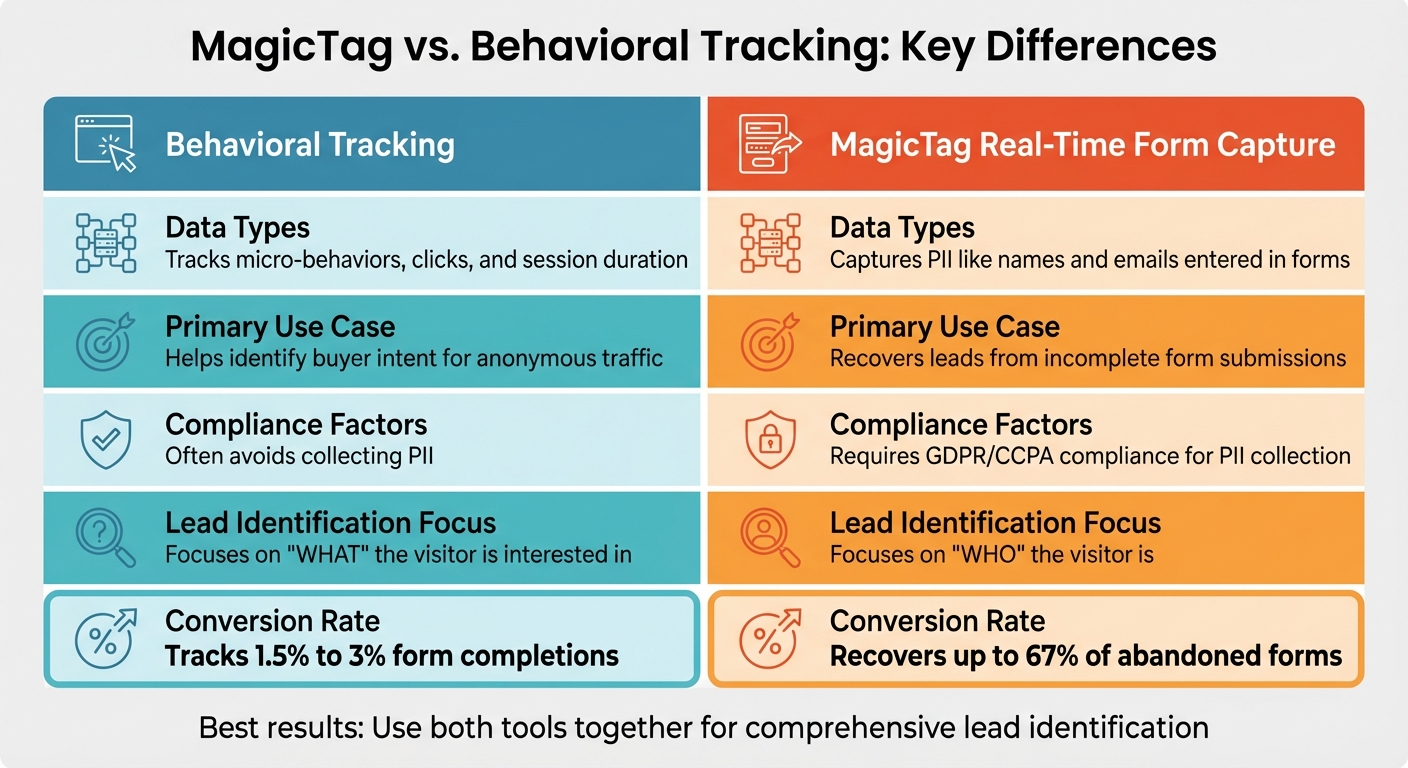
MagicTag vs Behavioral Tracking: Lead Identification Methods Compared
MagicTag takes IP tracking and behavioral analysis a step further by capturing live input data to help recover leads in real time. This tool turns abandoned forms into opportunities by collecting data as users type, enabling you to recover up to 67% of visitors who might otherwise leave without a trace.
How MagicTag Works
MagicTag works by recording every keystroke as users fill out forms. It collects information like names, email addresses, and phone numbers in real time, even if the user doesn't complete the form. This partial data is instantly synced to your CRM through a webhook or API, ensuring you never miss a lead.
The system operates via a lightweight JavaScript snippet that won’t bog down your website’s performance. Plus, it complies with GDPR and CCPA regulations by offering clear disclosures and opt-out options for collecting personally identifiable information (PII). Through its real-time dashboard, you can see exactly which visitors started filling out forms, what data they provided, and when they decided to leave.
Next, we’ll explore how you can integrate MagicTag into your website to start recovering leads right away.
Setting Up MagicTag
Getting started with MagicTag is straightforward. Here’s how:
- Add the JavaScript snippet from your MagicTag dashboard into your website’s header.
- Choose the form fields you want to track, such as email, name, and phone number.
- Adjust the capture settings to strike the right balance between gathering leads and maintaining a smooth user experience.
- Connect MagicTag to your CRM or marketing platform using its webhook or API. Map the form fields to your CRM properties to ensure the data flows seamlessly.
- Set up automated workflows to send personalized follow-up emails or retarget users who abandoned a form.
With just a few steps, you can turn incomplete form submissions into actionable leads.
MagicTag vs. Behavioral Tracking
While both MagicTag and behavioral tracking contribute to lead identification, they serve distinct purposes. Here’s a quick comparison:
| Feature | Behavioral Tracking | MagicTag Real-Time Form Capture |
|---|---|---|
| Data Types | Tracks micro-behaviors, clicks, and session duration | Captures PII like names and emails entered in forms |
| Primary Use Case | Helps identify buyer intent for anonymous traffic | Recovers leads from incomplete form submissions |
| Compliance Factors | Often avoids collecting PII | Requires GDPR/CCPA compliance for PII collection |
| Lead Identification | Focuses on "what" the visitor is interested in | Focuses on "who" the visitor is |
| Conversion Rate | Tracks 1.5% to 3% form completions | Recovers up to 67% of abandoned forms |
Behavioral tracking is great for gauging visitor intent and prioritizing accounts, while MagicTag excels at capturing contact details from high-intent users who leave forms unfinished. Together, these tools create a powerful system for turning anonymous website activity into actionable leads and insights.
sbb-itb-77d5bc3
Building a Privacy-Compliant Lead Recovery Workflow
After setting up MagicTag to capture form data in real time, the next step is creating a system that balances visitor privacy with effective lead recovery.
Designing Your Lead Recovery Pipeline
A solid lead recovery pipeline combines IP-based company identification, behavioral signals, and MagicTag's real-time form capture to give you a full view of your website visitors. For instance, if someone from a target account repeatedly visits your pricing page in a single week, that behavior can trigger an alert. If the same visitor starts filling out a contact form but leaves it incomplete, MagicTag captures partial details - like their name, email, or phone number - and syncs this data to your CRM instantly. This layered process allows your sales team to identify both the company (via IP) and the individual (via form capture), giving them the context they need for personalized follow-ups.
As third-party cookies are phased out, workflows must rely on first-party data. Server-side tracking and identity graphs can strengthen your system, while AI-powered fingerprinting tools can achieve an impressive 99.5% visitor identification accuracy rate.
The final step is integrating these data layers with your CRM to enable fast and precise follow-ups.
Connecting to CRM and Automation Tools
Seamless integration between MagicTag and your CRM is essential. MagicTag's webhooks and APIs work directly with platforms like Salesforce, HubSpot, and Pipedrive. When setting up this connection, align the field names in MagicTag with your CRM's terminology to ensure smooth data flow and reduce the need for manual corrections.
Use the captured data to automate lead follow-ups. For example, set up triggers to send personalized emails to visitors who abandon demo request forms or create Slack alerts when someone from a target account downloads a case study. In 2024, Formstack achieved a 420% increase in website conversions by using behavioral scoring to identify high-intent anonymous visitors and connecting them to live chat workflows. Similarly, PointClickCare boosted its sales funnel by 400% and generated over $1 million in additional revenue in just one year by prioritizing anonymous traffic based on intent scoring.
"It is very important to contact them as soon as possible, as that has proven impact on which provider the customer will choose."
– Johanna Rytkonen, Marketing and Communications Manager, Triuvare
Privacy and Compliance Best Practices
With your data pipeline in place, it’s crucial to ensure every step respects visitor privacy. Start by implementing transparent consent management. Use clear cookie banners that explain what data is collected and why. Visitors should have the ability to opt in or out, and your privacy policy must clearly outline how technologies like IP tracking and form capture are used.
Under GDPR, IP addresses are considered personal data, making explicit consent a requirement for collection. Similarly, CCPA demands clear disclosures about data usage and gives consumers the right to access, delete, or opt out of data collection. MagicTag is designed with GDPR and CCPA compliance in mind, offering opt-out options and clear disclosures for collecting personally identifiable information (PII).
Adhere to the principle of data minimization - only collect what’s necessary for legitimate business purposes. When tracking form fields, stick to essential contact details and avoid unnecessary data collection. Regularly audit your tracking tools to ensure they anonymize or mask personal data as required and respect "Do Not Track" signals. Additionally, review vendor agreements periodically to confirm they enforce strong data protection practices.
"Trust is the cornerstone of effective lead generation. When visitors understand and feel confident in your data practices, they're more likely to engage."
– LeadBoxer
Conclusion
Key Takeaways
Understanding anonymous traffic doesn’t have to be complicated. Tools like IP-based company identification can pinpoint the organizations visiting your site, while behavioral analytics and intent scoring help you prioritize visitors based on their actions - like checking out pricing pages or downloading case studies. Using first-party cookies ensures you can track repeat visits in a way that aligns with privacy regulations, and identity resolution connects these signals to databases, giving you insights into key firmographics and even individual decision-makers.
MagicTag steps in to fill the gaps by capturing partial details - like names, emails, and phone numbers - that traditional methods often miss. This ensures your lead profiles are as complete as possible, giving you a better chance to engage potential customers.
Privacy compliance is non-negotiable. Use clear consent banners, collect only the data you truly need, and make sure your tools adhere to GDPR and CCPA guidelines. As Albert Finder from Lift AI puts it:
"The only way to get actionable insights on EVERY anonymous web visitor is by analyzing their micro behaviors and buyer intent, as that does not require identification".
By focusing on behavioral data, you can respect privacy while still gaining the insights you need to make impactful decisions.
Next Steps
Now it’s time to put these strategies into action and recover lost leads.
Start by enabling real-time alerts for high-intent pages, such as pricing or demo request pages. Integrate your tracking tools directly with your CRM so that visitor data flows seamlessly into your sales pipeline. If you haven’t already, consider installing MagicTag - it can capture partial form submissions, helping you identify up to 12x more leads than traditional methods.
To ensure cleaner data, exclude internal and partner IPs from your tracking. Then, set up automated workflows to route high-intent leads directly to your sales team via Slack or email. With around 98% of website traffic leaving without filling out forms, recovering even a small portion of these visitors can translate into significant revenue. Acting quickly on these signals can make all the difference in boosting your conversion rates.
FAQs
How can IP tracking for company identification comply with GDPR?
IP-based company identification can adhere to GDPR regulations when it strictly focuses on business-level data and steers clear of handling personal information. This approach works by linking a visitor’s IP address to a corporate network, revealing details like the organization’s name, industry, or size - without gathering personal identifiers such as names or email addresses. Since this process only deals with company-related data, it doesn’t fall under the stricter GDPR consent rules that apply to personal data.
For compliance, this practice should align with Article 6(1)(f) – legitimate interest, which allows data processing for valid business purposes (like identifying potential B2B leads) as long as it doesn’t infringe on the visitor’s rights. Transparency is crucial here: your privacy policy should clearly outline what data is collected, how it’s used, and offer visitors the ability to opt out or request their company’s data be removed. Importantly, this method avoids using cookies or device fingerprinting, which means there’s no need for cookie consent.
Adopting data minimization and implementing strong security measures is also critical. This involves deleting raw IP data after processing, retaining only the enriched company information, and safeguarding the data with reliable technical protections. By taking these steps, IP-based company identification can support your business goals while staying within GDPR guidelines.
How is MagicTag different from traditional behavioral tracking?
MagicTag takes a different approach compared to traditional behavioral tracking by zeroing in on identifying anonymous website visitors - no forms or intrusive tracking needed. While behavioral tracking typically focuses on user actions like clicks or time spent on a page, MagicTag uses tools like IP tracking, reverse DNS lookups, and intent analysis to deliver actionable insights. And it does all this while adhering to privacy regulations like GDPR.
This method allows businesses to gather meaningful lead information without sacrificing user trust, making it an effective tool for refining marketing and sales processes in a privacy-focused world.
How does intent scoring help prioritize leads?
Intent scoring takes visitor behavior and translates it into a numerical value that highlights which prospects are most likely to make a purchase. By tracking actions like viewing pricing pages, interacting with product-focused content, or frequently returning to your site, the system calculates a score that indicates their buying intent. This helps sales and marketing teams prioritize high-potential leads while gradually nurturing those that need more time.
Since intent scores rely on measurable engagement data, they can integrate directly into your CRM. This enables features like real-time alerts, streamlined lead organization, and tailored follow-ups. Teams leveraging intent scoring often see quicker engagement with top leads, improved conversion rates, and smarter resource allocation, effectively turning anonymous website visitors into promising sales opportunities.