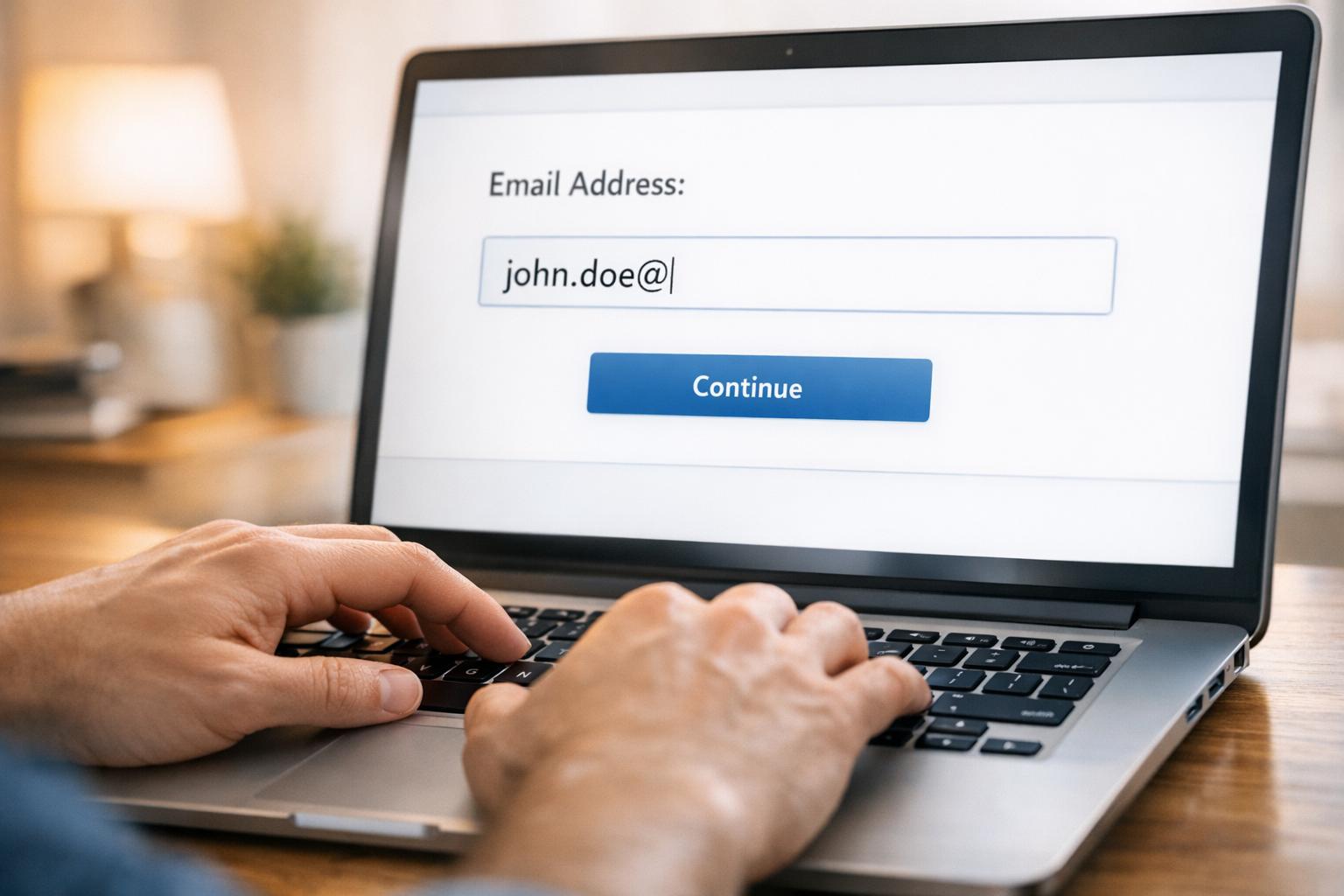
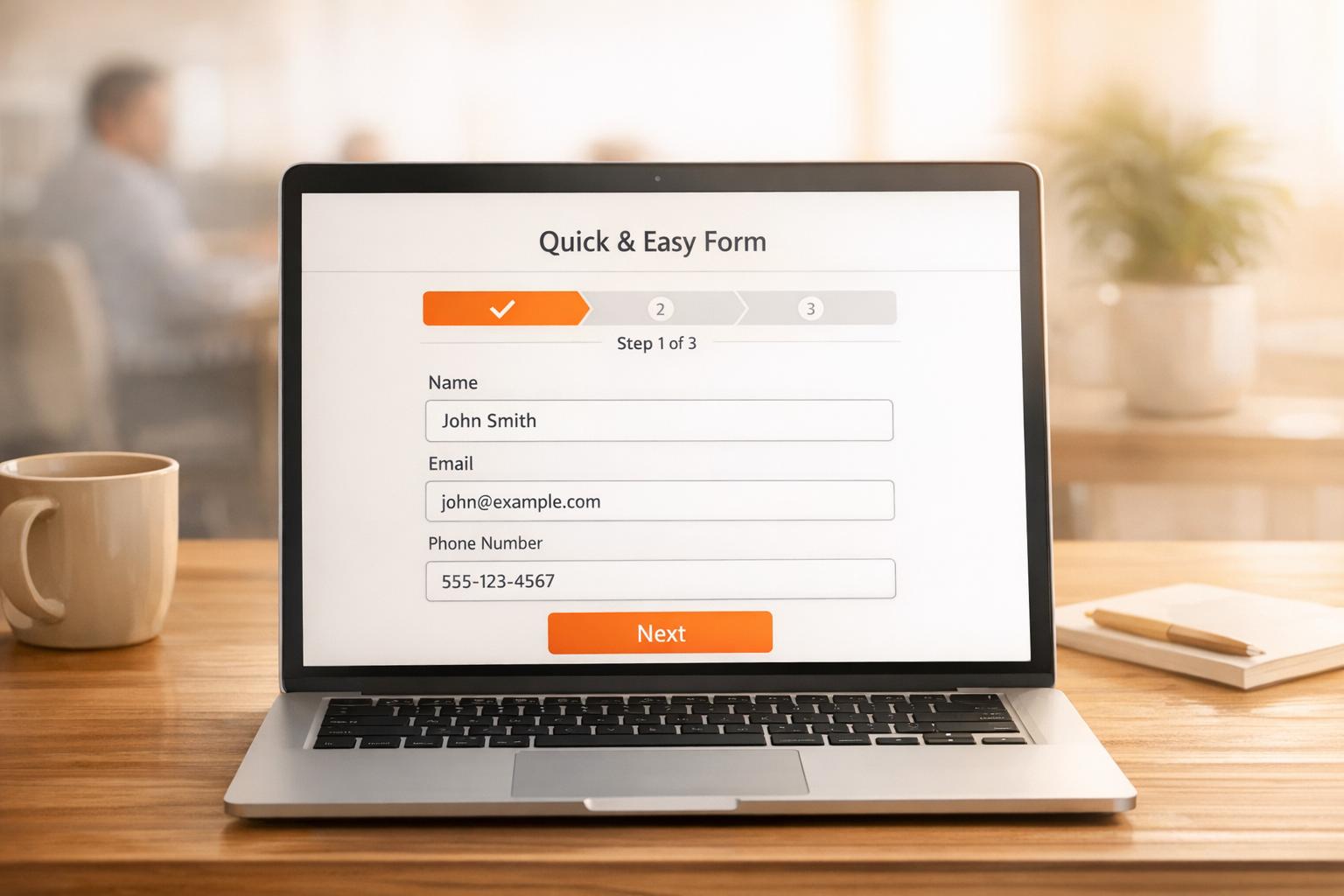
MagicTag is a tool designed for e-commerce businesses to recover lost leads by saving customer data - like emails and phone numbers - entered into forms, even if users abandon the checkout process. By syncing this data instantly with CRMs, it enables follow-ups within five minutes, a critical window where businesses are 100x more likely to close a sale. With over 70% of carts abandoned and $260 billion in lost orders annually in the U.S., MagicTag addresses this challenge by capturing data in real time and triggering automated recovery workflows.
Key Features:
- Saves partially entered customer details (e.g., email) without form submission.
- Integrates with platforms like Salesforce, HubSpot, and Klaviyo.
- Automates lead recovery with workflows, email, and SMS follow-ups.
- Tracks performance metrics like recovered revenue and conversion rates.
- Ensures compliance with privacy laws like GDPR and U.S. state regulations.
Why It Matters:
- Recovering just 10% of abandoned carts can increase revenue by 23%.
- Businesses using MagicTag report up to a 54% boost in conversions.
- Real-time engagement ensures timely follow-ups, improving lead conversion.
MagicTag is easy to set up with a lightweight script, supports API integrations, and offers plans starting at $19/month. By addressing cart abandonment and lead recovery, it helps e-commerce businesses maximize revenue and ROI.
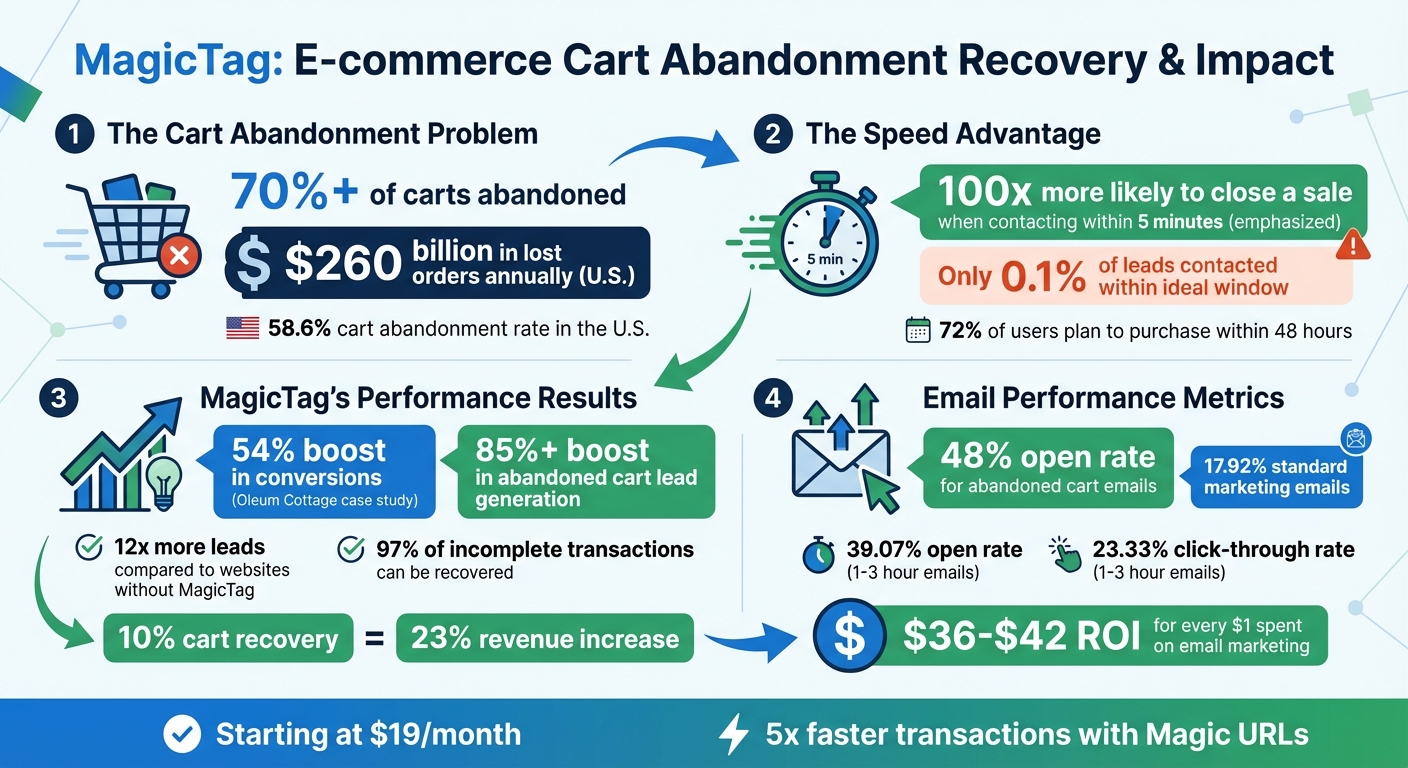
MagicTag Cart Abandonment Recovery Statistics and ROI Impact
How Lead Recovery Works in E-commerce
How Abandonment Affects Conversion Funnels
Every time a shopper leaves the checkout page without completing their purchase, a potential sale slips away. Traditional analytics tools might tell you when a cart is abandoned, but they usually only track data after a customer hits "submit" or "complete purchase." If someone enters their email in the checkout form but closes the tab before finishing, that lead often disappears. This creates a major blind spot - you're missing out on identifying customers who showed interest but didn’t follow through. With a cart abandonment rate of 58.6% in the U.S., that's a lot of missed opportunities. And when you consider that 21% of shoppers abandon their carts because the checkout process feels too long or complicated, it’s clear that addressing these issues is crucial. This is where MagicTag steps in, capturing even partially entered data to close these gaps.
How MagicTag Captures Data in Real-Time
MagicTag takes a different approach by capturing contact details as soon as they’re typed, instead of waiting for the form to be submitted. Using an auto-save feature, it stores information after just a few seconds of inactivity (roughly three seconds after the last keystroke). So, even if a shopper leaves mid-process, their details are saved.
MagicTag collects data at every stage of the checkout process - from the summary page to the address and payment sections. It also identifies returning customers, pre-filling their information to make the checkout process smoother. By continuously transmitting data, MagicTag enables instant recovery actions, like sending follow-up messages, even when users haven’t explicitly opted into marketing communications.
"The distinguishing feature of MagicTag lies in its capability to furnish customer data at every checkout stage, providing actionable data from the outset." - Razorpay
The results speak for themselves. In 2025, Oleum Cottage saw a 54% boost in conversion rates by using real-time data capture to send personalized emails to users who abandoned their checkout at various stages. Uberlyfe reported a 14% increase in conversions by identifying specific users for retargeting. Deodap also benefited, with a 10% sales lift thanks to address pre-fill functionality that made data entry easier. These examples underline how real-time data capture meets the needs of U.S. businesses.
U.S. E-commerce Considerations
MagicTag integrates seamlessly with popular CRMs like Salesforce, HubSpot, and Klaviyo, ensuring that captured lead data is synced immediately for fast follow-up. It also supports revenue tracking in USD, helping businesses calculate the "Value of Abandoned Orders" to focus on recovering the most valuable leads.
Speed is everything in the U.S. market. Companies that contact leads within five minutes are 100 times more likely to close a sale compared to those that wait, yet only 0.1% of inbound leads are contacted within this ideal window. MagicTag’s real-time triggers ensure recovery emails or SMS messages are sent within minutes of abandonment, reaching customers while their shopping experience is still fresh. Considering U.S. businesses spent $3.2 billion on lead generation in 2023, capturing partial form submissions isn’t just smart - it’s essential to protect your investment.
Setting Up MagicTag on Your E-commerce Website
Installation and Configuration
To get started, add the lightweight JavaScript tracking code to every page of your website - preferably right before the closing </body> tag. This placement ensures the script runs on key pages like product listings, cart pages, and checkout screens, capturing every potential lead.
Next, initialize the SDK using your publishable API key from the MagicTag Dashboard. After adding the script, configure it with deferPreload: true to delay static asset loading, helping maintain your site's speed. MagicTag simplifies integration with platforms like Shopify, BigCommerce, and WordPress, allowing you to set it up in just a few minutes - no developer needed.
Once installed, test the setup by interacting with your product pages, cart, and checkout forms. Check the MagicTag dashboard to confirm that data is being captured in real time. After verifying the script, the next step is mapping your form fields to collect essential customer data.
Mapping Form Fields for Lead Capture
Once the script is live, configure your forms to capture critical customer details. Early data capture is key to reducing missed opportunities and improving recovery rates. Start by mapping form fields in the MagicTag dashboard. This involves identifying key inputs like name, email, and phone number throughout your checkout process. MagicTag's early email capture feature saves customer data as soon as it's entered, even if the form isn't submitted.
To set this up, open your checkout page and identify the fields you want to track. For example, map the "Email Address" field and any other custom inputs unique to your business. Once mapped, the data will be captured as soon as a shopper begins entering information. After completing this step, you can connect MagicTag to your CRM and marketing tools, enabling real-time lead recovery.
Connecting to CRMs and Marketing Tools
MagicTag integrates seamlessly with popular marketing platforms like HubSpot, Klaviyo, and Mailchimp. You can connect these tools using webhooks, APIs, or third-party connectors like Zapier to automate workflows and synchronize data in real time.
For an even simpler approach, the Magical Chrome extension offers a no-code option to transfer data between your e-commerce platform and CRMs effortlessly.
"Magical is an agentic AI platform that deploys AI Employees to handle complex, end-to-end workflows across your systems - without APIs, integrations, or engineering lift." – Magical
To use the extension, download it, label your data fields, and then, within your CRM (e.g., HubSpot), type '//' in an empty field to auto-map the data. This streamlined process allows you to push abandoned cart data directly into email sequences or SMS campaigns, letting you reach out to leads within minutes of abandonment.
Advanced Abandoned Cart Ecommerce Email Automation Hacks | Tutorial 2025
sbb-itb-77d5bc3
Automating Lead Recovery with MagicTag
Leverage MagicTag's capabilities to automate lead recovery, ensuring you reconnect with potential customers quickly and effectively.
Segmenting and Prioritizing Leads
Effective lead recovery starts with smart segmentation. Break your leads into groups based on their behavior. For example, distinguish between those who abandoned their carts (high intent) and those who simply browsed product pages (lower intent). Cart abandoners are often just a small nudge away from completing their purchase, while browsers may need more engagement to pique their interest. Assign points to actions - like repeated visits to the pricing page - to identify your hottest prospects.
Additionally, consider segmenting leads by cart value. Focus your efforts on higher-value carts, as they represent greater potential revenue. For instance, you could set up different workflows: personal outreach for high-value carts and automated email sequences for lower-value ones. Targeted campaigns like these can boost conversion rates by up to 58% compared to generic email blasts.
Building Automation Workflows for Lead Recovery
A well-timed email sequence can make all the difference in recovering lost leads. Here’s a simple but effective three-email workflow:
- Email 1 (1–3 Hours): Send a friendly reminder with product images and a direct link back to the cart. A casual "Oops, did you forget something?" message works well here.
- Email 2 (24 Hours): Address common objections by including social proof, such as customer testimonials, or answering frequently asked questions.
- Email 3 (48–72 Hours): Create urgency with messaging like "Items running low" or offer a small discount to encourage action.
| Email Stage | Timing | Primary Goal | Suggested Content |
|---|---|---|---|
| Email 1 | 1–3 Hours | Reminder | Product image, link to cart, casual message |
| Email 2 | 24 Hours | Objection Handling | Social proof, FAQs, or small discount |
| Email 3 | 48–72 Hours | Conversion | Low stock alert, larger incentive |
To maximize recovery rates, consider combining email with SMS. Research shows that 72% of users who abandon their carts plan to purchase within 48 hours, making timely follow-ups crucial. Abandoned cart emails already perform exceptionally well, with an average open rate of 48% - far surpassing the 17.92% open rate of standard marketing emails.
Using Real-Time Triggers for Immediate Engagement
One of MagicTag's standout features is its ability to capture email addresses as soon as users type them into a form. This pre-submit tracking allows you to identify and engage with potential customers who abandon the process before reaching the final checkout stage - something traditional systems often overlook.
To make the most of this data, configure your CRM to receive it instantly using webhooks. Real-time alerts can then trigger follow-up messages tailored to user behavior. For example, abandoned cart emails sent within the first 1–3 hours boast a 39.07% open rate and a 23.33% click-through rate.
For high-value leads, set up alerts to notify your sales team when a prospect frequently visits the pricing page within a short time frame. Engaging with these prospects during the same session can recover 10%–30% of abandoned carts. By combining real-time tracking with automated workflows, you can create a seamless lead recovery system that boosts conversions and maximizes revenue potential.
Measuring Performance and Maintaining Compliance
Key Performance Metrics for U.S. E-commerce
Keeping tabs on performance metrics is crucial for building customer trust and adhering to regulatory standards. For example, tracking the lead recovery rate - the percentage of abandoned sessions converted through recovery efforts - can help you gauge MagicTag's effectiveness. Another important metric is recovered revenue, which measures the dollar value of orders saved from being lost forever.
You should also monitor the conversion rate lift, which reflects the incremental boost MagicTag provides through real-time lead capture. Keep an eye on the average order value (AOV) for recovered transactions to compare spending habits between recovered and regular buyers. Additionally, measure the customer lifetime value (CLV) of recovered leads to determine whether they become one-time purchasers or loyal, repeat customers.
Here’s a telling stat: businesses leveraging automation software generate 80% more total leads, and those using automation convert 77% more leads than businesses that don’t. Clearly, the right tools can make a massive difference.
But performance metrics alone aren’t enough. To make the most of these insights, your data practices must meet rigorous privacy and security standards.
Data Privacy and Compliance
MagicTag ensures compliance with major privacy regulations, including GDPR, LGPD, and various state laws in the U.S. (covering states like California, Virginia, Colorado, Texas, and Florida). By late 2025, 20 U.S. states had enacted comprehensive data privacy laws. To underscore the importance of compliance, consider these cases: the California Privacy Protection Agency (CPPA) fined Tractor Supply Company $1.35 million in September 2025 for failing to provide proper opt-out mechanisms, and California Attorney General Rob Bonta reached a $1.55 million settlement with Healthline Media for mishandling sensitive data.
To stay compliant, honor opt-out signals and ensure data collection notices are clear and accessible. Any personally identifiable information (PII) should be hashed using SHA256 before transmission to meet secure data handling standards. Transparency in how you use data not only keeps you compliant but also strengthens customer trust.
Best Practices for Data Handling
Implementing strong data security measures is non-negotiable. Use multi-factor authentication (MFA) to secure access to sensitive information. Practice data minimization by collecting only the essential fields needed for your operations. This approach not only simplifies compliance but also reduces your exposure to regulatory risks.
Keep detailed audit trails that include time-stamped records of when and how customer consent was obtained. These records are invaluable during regulatory audits or when responding to Data Subject Access Requests (DSARs). Ensure consent signals are automatically synced across your tech stack, including tools like CRMs, email platforms, and analytics systems. Consumers are quick to avoid businesses with poor data management practices, so earning their trust is critical.
Establish clear data retention policies and routinely review who has access to customer information. When integrating with CRMs such as HubSpot or Salesforce, confirm that service provider agreements align with state-specific privacy requirements. Combining robust security measures with transparent data practices not only keeps you compliant but also fosters trust with your customers in an ever-changing regulatory landscape.
Conclusion
Why MagicTag Matters for E-commerce
Cart abandonment is a huge challenge in U.S. e-commerce, with businesses pouring approximately $3.2 billion into lead generation efforts in 2023 alone. And yet, over 70% of carts are abandoned before checkout. That’s where MagicTag steps in, offering a game-changing solution by capturing customer data in real time - even when shoppers don’t hit submit. With this approach, it’s possible to recover up to 97% of incomplete transactions.
The results are hard to ignore: businesses using MagicTag see an 85%+ boost in abandoned cart lead generation, while Magic URLs in recovery emails can speed up transactions by as much as 5x. Timing is everything - reaching out within five minutes can significantly improve your chances of converting a lead. By combining real-time data capture with automated workflows, MagicTag ensures you’re not just recovering lost leads but also making the most of every dollar spent on customer acquisition. It can uncover up to 12x more leads compared to websites that don’t use it, turning anonymous visitors into valuable contacts. Plus, seamless integration with your CRM means your team can shift their focus to strategy and building meaningful customer relationships. These results highlight how easy it is to implement and how impactful it can be.
Getting Started with MagicTag
Getting MagicTag up and running is straightforward and scalable. Start with the free plan for up to 1,000 users per month, or upgrade to the Starter plan at just $19/month, which supports up to 10,000 users and includes full API access and CRM integrations.
To make the most of MagicTag, follow these key steps: map your form fields during setup, automate your five-minute response window, and leverage Magic URLs in your recovery campaigns. Regularly track metrics like lead recovery rates, recovered revenue, and conversion rate improvements to gauge your ROI. Considering email marketing’s average return of $36 to $42 for every $1 spent, the investment quickly pays off. Download the Chrome extension today and start turning abandoned carts into completed sales.
FAQs
How does MagicTag stay compliant with privacy laws while recovering leads?
MagicTag is built to meet the demands of modern privacy laws, offering businesses precise control over customer data processing. Its privacy-first features include clear consent tools, data minimization, and user preference management, ensuring personal data is neither sold nor misused. These measures help merchants stay in line with regulations like GDPR and various U.S. state privacy laws.
To strengthen compliance, MagicTag lets e-commerce businesses tailor data-handling rules based on regional requirements. It also provides tools to manage consent, handle data requests, and update privacy policies regularly. With these protections in place, MagicTag helps businesses recover leads and improve conversions - all while respecting customer privacy and staying legally compliant.
How do I set up MagicTag on my e-commerce site?
Currently, there’s no comprehensive guide available here for setting up MagicTag on your e-commerce site. To get started, it’s best to check out MagicTag’s official documentation or reach out to their support team for assistance.
If you have access to MagicTag’s resources, they likely include a detailed, step-by-step guide to help you integrate the tool smoothly into your platform.
How does MagicTag help recover leads and increase conversions in e-commerce?
MagicTag helps businesses recover lost leads and increase conversions by detecting when customers abandon forms or checkout pages. Once identified, it steps in with personalized follow-ups to nudge those potential buyers back, encouraging them to finish their purchase or complete the desired action.
This automated system not only saves time but also ensures every lead gets the attention it deserves. By turning missed opportunities into successful transactions, MagicTag helps e-commerce businesses boost revenue while keeping customers engaged.