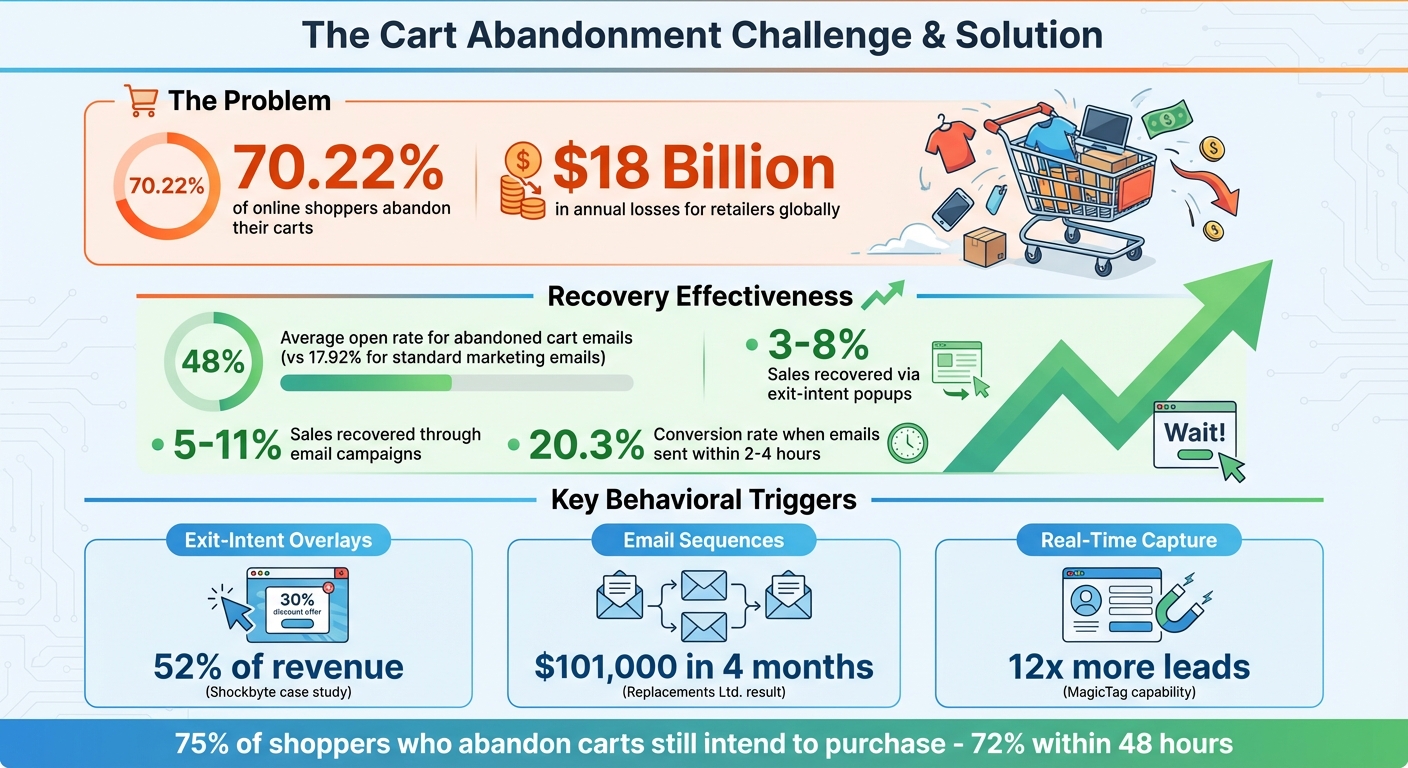
Did you know 70.22% of online shoppers abandon their carts? That translates to an estimated $18 billion in annual losses for retailers globally. But here’s the good news: behavioral triggers - like exit-intent popups, inactivity alerts, and personalized follow-ups - can help you recover lost sales and improve conversions.
Key Takeaways:
- Behavioral triggers respond to user actions (or inactions) in real-time, like offering discounts when someone hesitates at checkout.
- Psychological strategies like loss aversion and urgency (e.g., countdown timers) encourage shoppers to complete their purchases.
- Tools like MagicTag capture partial form data (like email addresses) to re-engage users even if they leave mid-checkout.
- Recovery tactics, including abandoned cart emails, can reclaim 5–11% of lost sales.
Quick Wins:
- Use exit-intent overlays to offer free shipping or discounts before a shopper leaves.
- Send a three-email sequence (starting 30 minutes after abandonment) to remind and incentivize customers.
- Implement inactivity triggers to address hesitation, like live chat for questions or prompts about free shipping thresholds.
By combining real-time tracking, psychological insights, and automated tools, you can significantly reduce cart abandonment and boost revenue. Let’s break it down further.
Cart Abandonment Statistics and Recovery Rates
Mapping the Cart Abandonment Journey
The 3 Stages of Cart Abandonment
Cart abandonment happens in three distinct stages. The first is the pre-abandonment stage, where shoppers are actively browsing your site, comparing products, and deciding if they trust your brand enough to make a purchase. Key strategies like transparent pricing, visible trust badges, and personalized product recommendations can help keep customers engaged during this phase. Next comes the abandonment intent stage, the pivotal moment when shoppers show signs they’re about to leave. Behavioral cues - such as sudden mouse movements toward the exit button or switching tabs - are telltale signs. Finally, there’s the post-abandonment stage, which begins once the shopper has left your site. At this point, the focus shifts to external channels like email, SMS, and retargeting ads to bring them back to their saved cart.
Yaniv Navot, CMO at Dynamic Yield, explains: "Shopping cart abandonment recovery solutions can be extremely effective for re-engaging customers throughout the various abandonment stages".
Behavioral Signals to Track
Recognizing behavioral signals at each stage is crucial for reducing cart abandonment. For instance, cursor movement is a strong indicator - rapid movements toward the browser toolbar often signal exit intent. Another red flag is text highlighting, which suggests shoppers may be preparing to compare prices on competitor sites. On the checkout page, inactivity or hesitation - especially long pauses - can point to confusion or surprise over unexpected costs like shipping fees. Even tab switching offers insights; when users move to other tabs, you can grab their attention with browser notifications that change the tab title.
During the pre-abandonment phase, watch for signs of frustration, such as "dead clicks" (clicking on non-clickable elements) or "rage clicks" (repeated rapid clicks), which often indicate usability issues. In the post-abandonment stage, it’s all about engagement metrics: email open rates, click-through rates, and SMS response rates reveal how effective your recovery campaigns are. Tracking these signals with precision ensures you can act quickly to recover lost sales.
Technical Requirements and Data Setup
Capturing these behavioral signals requires a solid technical setup. Start by configuring event tracking in Google Analytics 4 (GA4) to monitor key actions like add_to_cart, begin_checkout, and purchase. Use pre-submit tracking to collect email addresses as users type them, which allows you to follow up even if they abandon the form before submitting it. Implement session management by setting a "Session Timeout Limit" (typically 30 minutes) to determine when a session is officially abandoned and ready for recovery workflows.
Compliance with privacy laws is non-negotiable. For email campaigns, follow CAN-SPAM regulations by including clear opt-out options. For SMS, adhere to TCPA rules, ensuring you have prior written consent and send messages within 48 hours of abandonment. Additionally, cookie management is essential for remembering cart contents for users who aren’t logged in, while suppression rules help avoid sending recovery messages to customers who’ve already made a purchase. Lastly, ensure your site includes SSL certificates and recognizable trust seals - 17% of shoppers abandon carts due to security concerns about entering their credit card information.
With these technical tools and safeguards in place, you’re well-positioned to implement effective recovery strategies later in the process.
Behavioral Triggers That Reduce Cart Abandonment
Exit-Intent Overlays
Exit-intent technology steps in when a shopper’s cursor moves toward the browser’s close button or address bar. At that moment, a targeted overlay pops up with an offer designed to keep them engaged. The trick? Focus on high-intent pages like your cart or checkout. Don’t rely on generic messages; instead, personalize these overlays with incentives such as "Save your cart & we’ll text you the link" or a "price freeze" that locks in the current price for a short time. For shoppers who seem hesitant, providing a contact form or live chat option can address their concerns instantly.
Take Shockbyte, for example. Their exit-intent campaigns have made a huge difference, driving 52% of the company’s revenue. And when it comes to calls-to-action, keep the tone low-pressure with phrases like "View Your Cart" or "See Your Items." This approach respects the shopper’s decision-making process while keeping the door open for conversion. On average, exit-intent popups can recover between 3% and 8% of abandoned cart sales.
But exit-intent overlays aren’t the only tool to re-engage shoppers. Inactivity triggers can also make a big impact.
Inactivity and Hesitation Triggers
When a shopper remains inactive for about 60 seconds, it’s often a sign they’ve gotten distracted. That’s where an automatic trigger can step in to re-engage them. For carts with high-value items, consider adding a live chat "concierge" to offer personalized help. Alternatively, use radio buttons to address common concerns like "Questions about returns?" or "Need shipping details?".
Another smart move is to trigger a chat pop-up when a cart is close to reaching the free shipping threshold, nudging the shopper to add just one more item. Skate.co.uk saw great results with this strategy, setting an inactivity trigger to 25 seconds on their cart and checkout pages. The result? A 6.29% conversion rate from previously inactive mobile visitors. Testing different inactivity intervals can help you strike the right balance between being helpful and intrusive.
To round out the recovery process, email and SMS campaigns can bring hesitant shoppers back.
Abandoned Cart Emails and SMS
A well-planned email sequence outshines a single follow-up every time. Start with the first email, sent 30 to 60 minutes after the cart is abandoned. This email should focus on customer service, offering help with any technical issues or questions about completing the order.
Mike Arsenault, Founder & CEO of Rejoiner, advises: "The first email you send should have no other purpose other than to provide responsive customer service."
The second email, sent 24 hours later, builds trust with social proof - like reviews or staff picks. If you include an incentive, keep it modest, such as free shipping. The final email, sent at the 72-hour mark, introduces urgency with scarcity messaging, like "Only 2 left in stock" or a limited-time discount code.
For instance, Replacements, Ltd. used the Emarsys platform for a cart abandonment campaign between August and December 2021. The campaign generated over $10,000 from the initial send and racked up $101,000 in total revenue within four months, achieving a 14% conversion rate. Similarly, ShineOn recovered more than $101,000 in just 30 days by using Cartloop’s human-powered SMS platform to reconnect with shoppers who had left their carts behind.
When it comes to SMS, keep things direct. Include links that take shoppers straight to their cart or checkout, ideally with pre-applied discounts. Use dynamic, one-time-use coupon codes to prevent public sharing and protect your margins.
Carl Sednaoui, Director of Marketing at MailCharts, highlights: "By sending out one or more emails, companies can typically recover between 5% and 11% of otherwise lost sales."
| Sequence Step | Timing | Primary Content Focus | Recommended Incentive |
|---|---|---|---|
| Message 1 | 30–60 Minutes | Customer Service / Reminder | None (to protect profit margins) |
| Message 2 | 24 Hours | Social Proof / Urgency | Modest incentive (e.g., free shipping) |
| Message 3 | 72 Hours | Final Reminder / Strong Offer | Higher incentive (e.g., 10–20% discount) |
The 8-Figure Cart Abandon Email Flow That Recovers 300% More Lost Sales (Klaviyo Email Marketing)
sbb-itb-77d5bc3
Real-Time Data Capture for Abandoned Forms and Carts
Once you’ve set up effective tracking and technical systems, capturing data in real time becomes a game-changer in re-engaging distracted shoppers.
Why Real-Time Form Capture Is Important
Picture this: a shopper starts filling out a checkout form, entering their email, but gets distracted - maybe by a phone call or by comparing prices elsewhere. If that email isn’t captured right away, it’s gone. Without it, recovery workflows can’t even begin.
Real-time data capture solves this by logging clicks, scrolls, and keystrokes as they happen. This ensures you can follow up, even if the shopper never clicks "buy". Considering that 75% of shoppers who abandon carts still intend to purchase the same product later - 72% within 48 hours - capturing contact details early is crucial for re-engagement. Timing matters too: recovery emails sent within 2–4 hours convert at 20.3%, compared to just 12.2% when delayed. Real-time capture sets the stage for tools like MagicTag to step in and drive those recoveries.
How MagicTag Boosts Lead Recovery
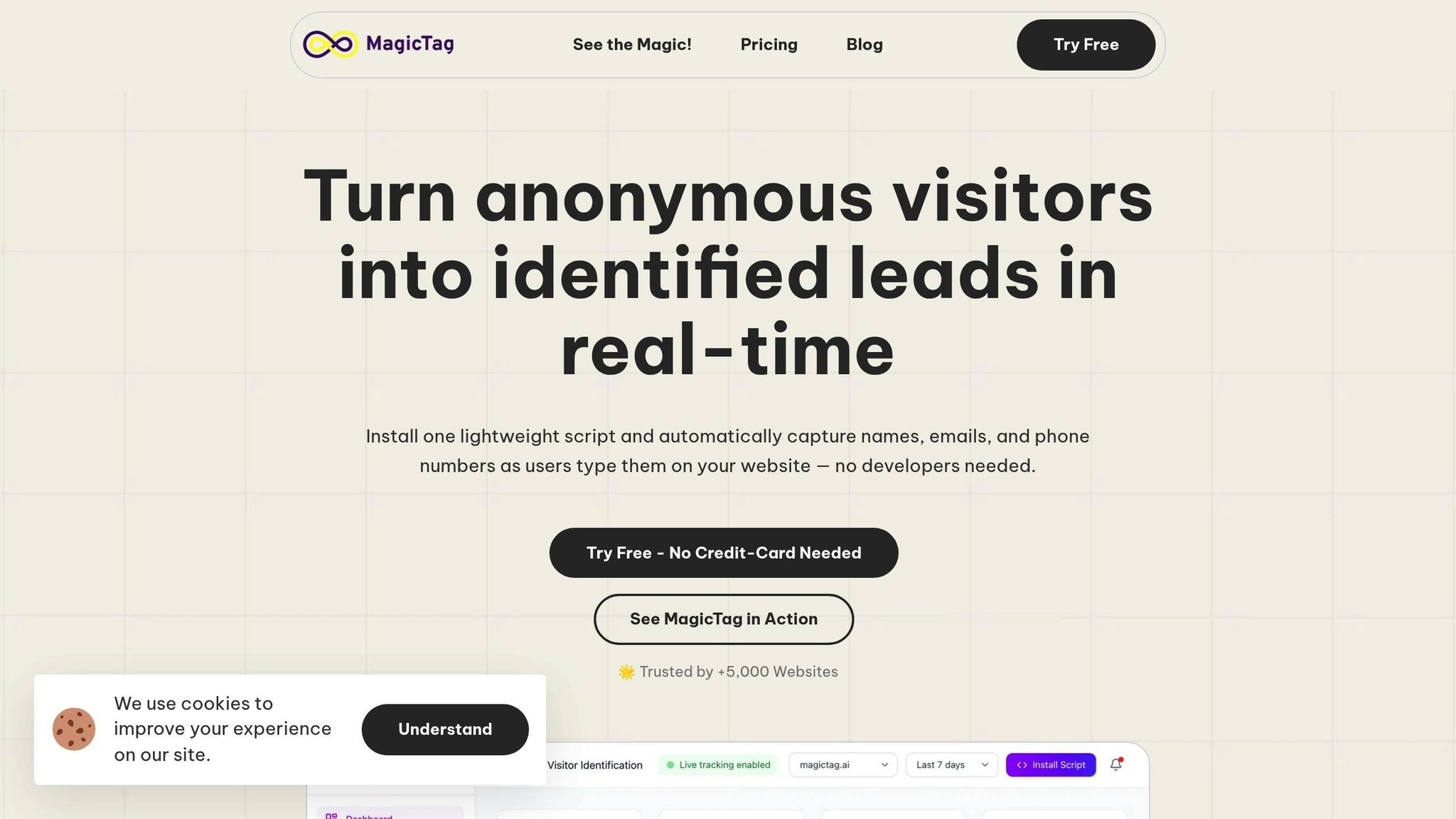
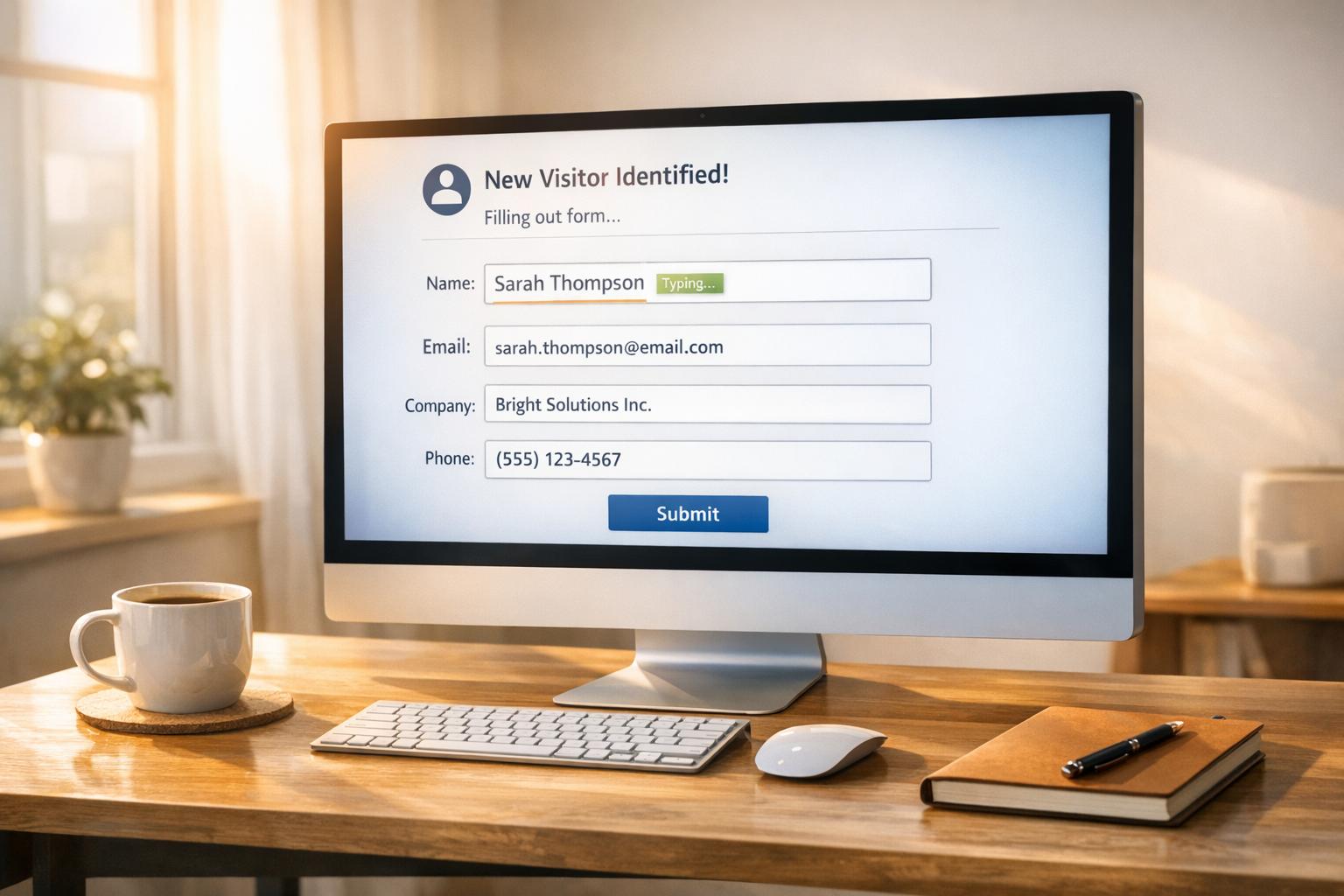
MagicTag is designed to grab user data (like name, email, and phone number) as soon as it’s typed - even if the form isn’t submitted. It connects directly to CRMs through webhooks or APIs, instantly feeding this data into your system to trigger recovery workflows. This seamless integration powers automated campaigns to bring shoppers back.
By saving partial form data the moment someone starts typing, MagicTag helps websites identify up to 12x more leads than those waiting for full submissions. It’s easy to install, works on any website without requiring a developer, and complies with GDPR and LGPD regulations. For small businesses, the free plan captures up to 1,000 users per month, while paid plans start at $19/month for up to 10,000 users, offering API access, CRM integration, and priority support.
Real-World Uses for MagicTag
Once you’ve captured the data, MagicTag opens up practical ways to recover lost sales. For instance, it’s perfect for rescuing high-value carts. Imagine a shopper adds $500 worth of products to their cart, starts entering their email, but leaves. MagicTag records that partial data, allowing you to send a personalized SMS or email within the hour, complete with a "one-click resume" link that restores their cart.
Another handy feature is segmenting users based on partial form details. If someone enters a phone number but doesn’t finish their shipping address, they can be flagged as a high-intent lead. These users might get routed to a live chat agent or receive personalized follow-ups addressing common concerns like shipping fees or return policies.
For mobile shoppers - who often abandon carts due to small screens and tedious data entry - MagicTag’s "save & text me" option can be a lifesaver. Shoppers can save their progress and get an SMS link to finish checkout on another device, reducing friction and reclaiming lost sales.
Optimizing Behavioral Triggers for Better Results
Once your technical setup is solid, fine-tuning behavioral triggers can significantly boost cart recovery efforts. These triggers play a crucial role in reducing cart abandonment and reclaiming lost sales.
Metrics to Track Trigger Performance
To evaluate how well your triggers are working, focus on these key metrics:
- Cart recovery rate: Generally falls between 10–15%.
- Open rate: Averages around 40%.
- Click-through rate (CTR): Typically hovers near 20%.
- Incremental lift: This measures the additional revenue generated by triggers compared to a control group.
To track incremental lift, set up a control group of shoppers who don’t receive recovery emails. Compare their conversion rates to those who do. Keep a close eye on your unsubscribe rate as well - if it spikes, it could mean your messaging is too frequent or aggressive.
A/B Testing and Continuous Improvement
Experimentation is key to optimizing your triggers without annoying your audience. Start by testing the timing of your first recovery email - sending it 30 to 60 minutes after cart abandonment often yields good results.
Next, test different types of incentives. For example, you could offer:
- A 10% discount
- Free shipping
- A free gift
Interestingly, research shows that 81% of recovery offers use percentage-based discounts, with 10% being the most popular.
"Sending an offer too early can train customers who would otherwise be willing to pay full price to abandon carts and wait for an offer." – Rejoiner
You can also test subject lines and calls-to-action (CTAs). Compare casual prompts like "Hey, you forgot something!" with more direct messages such as "You left items in your cart." Use specific CTAs like "Complete Your Purchase" instead of vague ones like "Return to Cart."
When introducing new triggers, start with a controlled audience to gauge their effectiveness. For discounts, use unique, single-use codes to prevent sharing and make tracking easier.
The goal is to strike a balance - maximize performance while maintaining a seamless experience for your users.
User Experience and Privacy Compliance
Managing the frequency of your triggers is essential. Use caps and suppression rules to avoid overwhelming customers, and ensure that triggers don’t go out to recent purchasers. A smooth, respectful approach builds trust and encourages conversions.
For privacy compliance, use a consent manager to categorize cookies into Required, Functional, and Advertising. This ensures behavioral triggers only activate when users have given the appropriate consent. Reinforce trust by displaying security badges and linking to your privacy policy during checkout.
Timing also matters - 98% of successful first recovery emails are sent within 24 hours. However, overly persistent follow-ups can harm your customer relationships and damage your sender reputation in the long run.
Conclusion
Key Takeaways
Cart abandonment doesn’t have to mean lost sales. By using the right behavioral triggers, you can win back a large chunk of those abandoned carts. For instance, abandoned cart emails boast an impressive open rate of around 48%, which is significantly higher than the average 17.92% for standard marketing emails. Combine these with exit-intent overlays, SMS messages, and retargeted ads to keep shoppers engaged.
Real-time user behavior tracking is a game changer. Tools like MagicTag capture browsing data instantly, helping you identify up to 12x more leads compared to traditional methods. This allows you to act on shoppers who showed purchase intent but didn’t complete checkout, turning anonymous visitors into actionable leads.
Timing plays a critical role. Sending a personalized recovery email within an hour of abandonment can make all the difference. Use behavioral insights to address customer concerns, such as offering free shipping or showcasing social proof. As Salesforce aptly notes:
"If you can get even a few people to come back and complete their purchase, you increase revenue and strengthen the customer experience".
Start applying these strategies today with the steps outlined below.
Next Steps for Implementation
Begin by auditing your current cart abandonment rate using GA4 or your eCommerce analytics platform. This will give you a baseline to measure improvements as you implement new recovery tactics. Then, map out the customer journey to identify where and why users abandon their carts. Common culprits include unexpected shipping costs, a complicated checkout process, or security concerns.
Once you’ve identified these pain points, set up your recovery sequence using behavioral triggers. Start with exit-intent overlays to capture shoppers before they leave. Follow up with a three-email series: a reminder email sent one hour after abandonment, an incentive at the 24-hour mark, and a final offer at 48 hours. To maximize your efforts, consider integrating MagicTag to capture form data in real time, even when customers abandon mid-checkout. This data can be seamlessly synced with your CRM via webhook or API, making it easy to incorporate into your marketing automation.
Finally, commit to ongoing testing and optimization. Experiment with A/B testing for subject lines, offers, and timing to see what resonates most with your audience. Track key metrics like cart recovery rate, email open rates, and overall revenue lift compared to a control group. With the right triggers and real-time tools in place, abandoned carts can shift from being a challenge to a dependable source of revenue.
FAQs
How can behavioral triggers help reduce cart abandonment?
Behavioral triggers are a smart way to tackle cart abandonment by responding directly to a shopper’s actions. Let’s say someone adds items to their cart but doesn’t proceed to checkout - this is where a timely pop-up or follow-up email can step in to gently remind them. Sweetening the deal with perks like free shipping or a small discount can make the nudge even more effective.
Tools like MagicTag take this a step further by capturing customer details - like their name, email, or phone number - as soon as they start typing them into a form, even if they don’t hit submit. This information enables businesses to send personalized emails or SMS messages right after a cart is abandoned, keeping the shopper in the loop. Pairing these reminders with retargeting ads that showcase the exact items left behind can create a sense of urgency and rekindle the shopper’s interest. This approach not only keeps the items fresh in their mind but also increases the chances they’ll return to complete the purchase.
What do I need to set up behavioral triggers for reducing cart abandonment?
To set up behavioral triggers effectively, you’ll need three essential tools: real-time data tracking, CRM or marketing platform integration, and automated messaging capabilities.
Start by adding a tracking snippet to your website. This snippet collects real-time data on user actions, such as clicks, scrolling, or form submissions. This data serves as the backbone for creating personalized triggers. Then, connect this data to your CRM or marketing platform using an API or webhook. This connection allows you to set rules - for example, sending a reminder if a user adds an item to their cart but doesn’t check out within 30 minutes. Be sure to include product details like SKUs, pricing, and images to make your messages more relevant.
Lastly, establish automated communication channels like email, SMS, or on-site notifications to send timely and personalized follow-ups. To maintain trust, ensure your setup complies with data privacy laws (like GDPR or LGPD) and always offer users the option to opt out of communications.
How does MagicTag help recover leads from abandoned shopping carts?
MagicTag is a tool designed to help businesses recover abandoned cart leads by capturing shoppers' contact details - like their name, email, and phone number - in real-time as they type them into form fields. Even if the shopper doesn’t complete their purchase, this information is automatically synced to your CRM. This means you can quickly roll out personalized retargeting efforts, such as email reminders or exit-intent pop-ups, to bring them back.
With the ability to identify up to 12 times more leads, MagicTag simplifies re-engaging potential customers and increasing conversions. Plus, it’s straightforward to set up and fully adheres to GDPR and LGPD regulations, ensuring compliance while you grow your business.