MagicTag transforms how businesses collect leads by saving user data in real-time, even if forms are abandoned. Unlike older methods that rely on completed forms, MagicTag reduces friction, improves data accuracy, and integrates seamlessly with CRMs like HubSpot and Salesforce. Traditional tools, while still used in specific scenarios like events or gated content, often struggle with slow response times, manual entry errors, and low conversion rates.
Key differences include:
- Real-Time Data Recovery: MagicTag saves partial form data before submission; older tools lose abandoned leads.
- Automation: MagicTag syncs instantly with CRMs, while older methods rely on manual data entry.
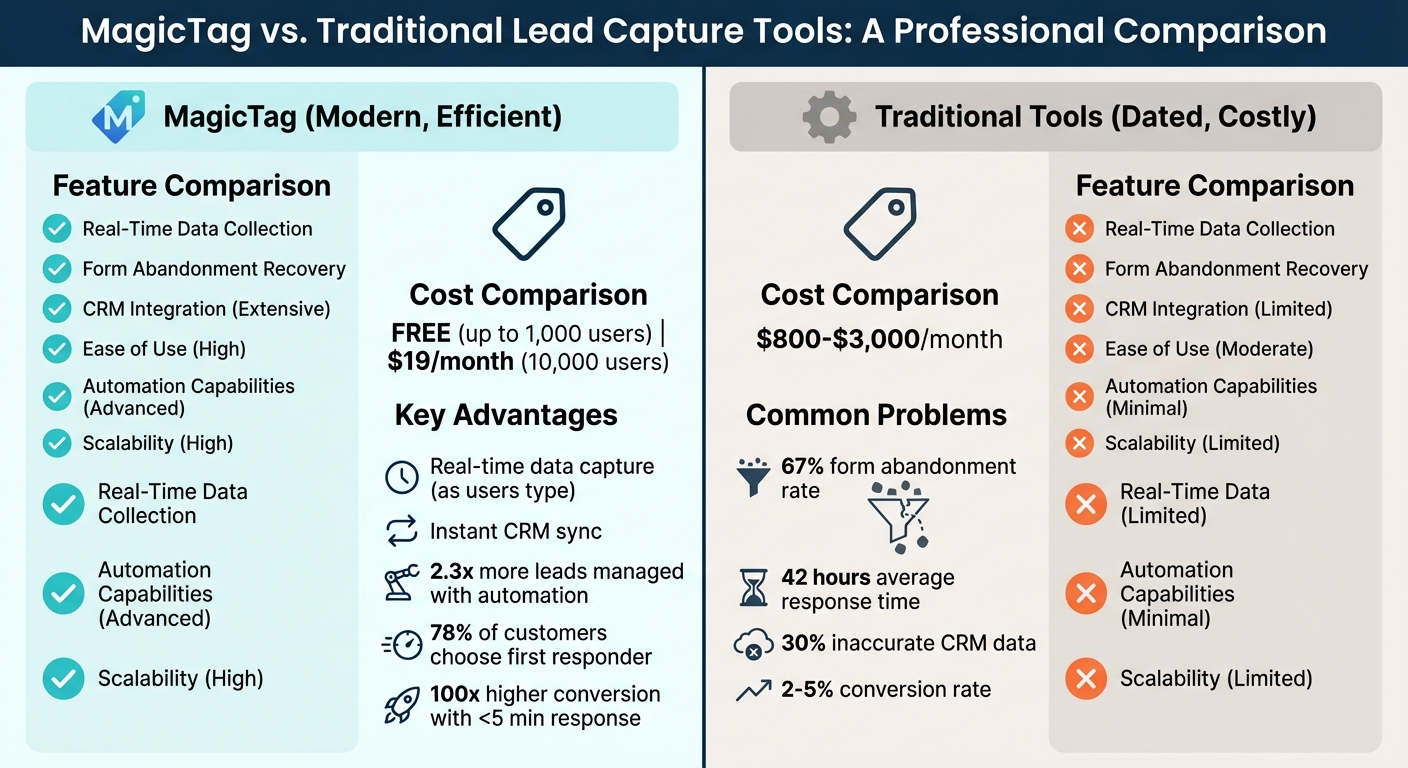
- Cost: MagicTag starts at $19/month for 10,000 users, while older systems often cost $800–$3,000/month.
Quick Comparison
| Feature | Older Tools | MagicTag |
|---|---|---|
| Real-Time Data Collection | No | Yes |
| Form Abandonment Recovery | No | Yes |
| Integration with CRMs | Limited | Extensive |
| Ease of Use | Moderate | High |
| Automation Capabilities | Minimal | Advanced |
| Scalability | Limited | High |
MagicTag is ideal for businesses prioritizing speed, efficiency, and recovering lost leads, while older methods still suit niche use cases like physical events or cold outreach. For most modern needs, MagicTag offers a more efficient, cost-effective solution.
MagicTag vs Traditional Lead Capture Tools: Feature and Cost Comparison
How Older Lead Capture Tools Work
Common Methods Used in Older Systems
In the early days of lead capture, businesses leaned on static forms, popups, and overlays to gather visitor information. These tools required users to manually input their details on landing pages or in triggered windows, forming the backbone of early lead-generation strategies. While these methods were a starting point, they quickly revealed their limitations.
Another hallmark of older systems was manual data entry. Sales teams often spent countless hours transferring information from platforms like LinkedIn or databases such as ZoomInfo into CRMs like Salesforce. Additionally, cold outreach was a common practice - sales reps would proactively call or email potential leads who hadn’t yet interacted with the brand. Basic email sign-up boxes, often tucked away in website footers, were another widely used approach.
"Lead capture is the system you use to gather contact information from prospects who are interested in your business as part of your lead-generation process." - Ehtisham Hussain, Freelance Marketer
Problems with Older Lead Capture Tools
While these methods were once standard, they came with a host of challenges that made them inefficient by today’s standards. One of the biggest hurdles was high friction. On average, 67% of users abandon forms before completing them. That means two out of three potential leads leave without submitting their information, making them permanently lost in older systems.
Another significant issue was delayed response times. Manual processes and slow CRM synchronization often resulted in average response times of over 42 hours. This delay not only frustrated prospects but also reduced the likelihood of converting them into customers. Compounding this problem was the prevalence of errors - manual data entry often led to 30% inaccurate CRM data, including typos, fake email addresses, and incomplete phone numbers. These inaccuracies wasted valuable resources and left sales teams chasing dead ends.
Conversion rates were also a challenge. Traditional methods typically converted at a rate of just 2-5%. Without real-time engagement options like SMS or live chat, these tools relied on delayed follow-ups, missing opportunities to interact with leads when they were most interested.
When Older Methods Are Still Used
Despite their drawbacks, traditional lead capture methods still have their place in specific scenarios. For instance, physical events often depend on manual sign-in sheets or on-the-spot data collection when digital tools aren’t practical. Similarly, static forms remain useful for offering high-value gated content - like whitepapers or research reports - that visitors are willing to trade their information for.
In some cases, quizzes and surveys continue to perform well because people are more likely to share their details when they anticipate a personalized outcome. Cold calling, too, can still be effective in certain contexts - 69% of buyers have accepted cold calls from new providers, and 82% are open to meetings with proactive sellers. However, these approaches require significant time and customization due to low response rates.
Small businesses with tight budgets or minimal lead-generation needs may also stick with basic tools. While these methods are affordable, they lack the automation and real-time features that drive higher conversions. These niche applications show why many businesses are shifting to modern solutions for faster, more accurate lead capture.
What MagicTag Offers: A Current Approach
Real-Time Lead Recovery
MagicTag changes the game by capturing visitor information as they type into form fields - even before they hit submit. Unlike traditional tools that only collect data once a form is fully submitted, MagicTag records details like names, emails, and phone numbers in real time, field by field.
This means businesses can still recover leads even if a visitor gets distracted, changes their mind, or closes the browser tab mid-process. It’s like having a safety net for potential customers who don’t complete forms.
Integration with CRMs and Marketing Platforms
MagicTag doesn’t just stop at capturing data - it ensures that data flows seamlessly into the tools businesses already use. With integrations through webhooks and APIs, MagicTag connects with platforms like HubSpot, Salesforce, ActiveCampaign, Mailchimp, and Google Analytics.
This real-time sync allows marketing teams to trigger personalized email campaigns instantly, while sales teams see new leads show up in their CRM without any lag. It creates a unified, up-to-date customer view, making it easier to act on fresh opportunities.
Easy Setup and Scalability
Setting up MagicTag is simple. A lightweight browser-based script gets added to your site - no coding or developer assistance required. Once installed, it starts capturing leads right away, eliminating the need for manual data entry.
As businesses grow, MagicTag grows with them. The platform can handle anywhere from 1,000 to over 50,000 leads per month, scaling effortlessly with automated workflows. Plus, it ensures compliance with GDPR and LGPD regulations, safeguarding both businesses and their customers. With automation managing up to 2.3 times more leads than manual processes, sales teams can focus on closing deals instead of chasing data.
6 Automations To Generate More Leads Than You Can Handle
sbb-itb-77d5bc3
MagicTag vs Older Lead Capture Tools: Direct Comparison
Lead capture has come a long way, shifting from traditional manual methods to highly automated solutions. Here's how MagicTag stands out when compared to older tools in terms of efficiency and scalability.
Feature Comparison Table
The differences between MagicTag and traditional lead capture methods become crystal clear when you compare their features side by side:
| Feature | Older Tools | MagicTag |
|---|---|---|
| Real-time Data Collection | No | Yes |
| Form Abandonment Recovery | No | Yes |
| Integration with CRMs | Limited | Extensive |
| Ease of Use | Moderate | High |
| Automation Capabilities | Minimal | Advanced |
| Scalability | Limited | High |
Older tools typically cost between $800 and $3,000 per month. In contrast, MagicTag offers a free plan for up to 1,000 users each month, with paid options starting at $19/month for 10,000 users.
Advantages and Disadvantages of Each Approach
The feature gap between MagicTag and traditional methods translates into distinct pros and cons for businesses.
Older tools rely solely on completed form submissions, meaning any visitor who abandons a form is lost as a lead. This approach often struggles with long forms that create friction, and studies show that personalized CTAs convert 42% more visitors into leads compared to generic ones. Additionally, traditional tools lack the ability to personalize interactions in real time.
MagicTag addresses these shortcomings by capturing data as visitors type, even if they never hit "submit." This not only recovers abandoned leads but also ensures higher data accuracy through real-time validation and enrichment, reducing the risk of outdated contact information. However, it’s worth noting that MagicTag is focused on lead recovery and enrichment rather than being a comprehensive marketing platform.
Business Scenarios Where MagicTag Works Best
MagicTag delivers the most value in scenarios where businesses need immediate, high-quality data to drive results.
For example, it’s an excellent tool for revitalizing outdated prospect databases. Instead of waiting for fresh form submissions, businesses can upload inactive lists and let MagicTag identify valuable leads with up-to-date B2B contact information. This is particularly useful for sales teams that rely on direct-dial mobile numbers for faster outreach, rather than generic office lines.
Another strength lies in reducing form friction. MagicTag simplifies forms, requiring minimal input while still capturing detailed information like company ad spend, headcount, and competitor insights. It also empowers businesses to track first-party intent signals - such as job postings or social media activity - so sales teams can engage prospects based on real-time behavior rather than waiting for form completions.
Conclusion: Selecting the Right Lead Capture Tool
Main Differences Summary
When comparing MagicTag to traditional lead capture tools, the standout differences are in speed, automation, and data recovery. Traditional tools depend on completed form submissions and manual data entry, which often create delays. These delays can significantly impact conversion rates - consider this: 78% of customers choose the first company to respond to their inquiry, yet only 37% of businesses respond within an hour. MagicTag, on the other hand, captures data in real time, even if visitors abandon forms before submitting.
Cost is another differentiator. While enterprise tools like HubSpot and Marketo come with hefty price tags - starting at $800/month and $1,995/month respectively - MagicTag offers a more accessible pricing structure, with a free plan for up to 1,000 users per month and paid plans starting at just $19/month for 10,000 users.
These differences highlight the essential factors to consider when choosing a lead capture tool.
How to Choose the Right Tool
To select the best lead capture tool for your business, start by assessing your response time needs. If your sales success hinges on quick engagement, prioritize tools that enable responses within five minutes. Why? A response time under five minutes can make your conversion chances 100 times higher compared to a 30-minute delay. Additionally, businesses that respond within an hour are nearly 7 times more likely to have meaningful conversations with decision-makers.
Next, evaluate your integration requirements. MagicTag integrates effortlessly with popular CRMs like HubSpot and ActiveCampaign using webhooks and APIs, eliminating the inefficiencies of manual data entry.
Finally, think about your lead sources. If recovering abandoned form data or enriching B2B leads in real time is your priority, MagicTag offers capabilities that deliver measurable results. While traditional tools may still suit enterprises with complex lead scoring or long-term nurturing needs, modern automation tools like MagicTag are the better choice for teams focused on speed, efficiency, and recovering lost leads.
FAQs
How does MagicTag boost lead conversion rates compared to traditional methods?
MagicTag boosts lead conversion rates by combining speed, personalization, and automation into one powerful system. It integrates seamlessly with your CRM, instantly syncing captured leads and triggering real-time follow-ups. This ensures prospects are contacted within minutes - a strategy proven to boost engagement and increase the likelihood of conversions.
With AI-driven personalization at its core, MagicTag tailors offers and messages based on each visitor's behavior, delivering a customized experience that attracts higher-quality leads. On top of that, its automation tools take care of repetitive tasks like data entry, lead scoring, and nurturing workflows. This frees up your sales team to concentrate on closing deals. By streamlining these processes, MagicTag delivers a smoother, more effective approach compared to outdated, manual lead capture methods.
What are the cost benefits of using MagicTag for lead capture?
Using MagicTag for lead capture can save businesses a lot of money by cutting out the need for pricey hardware or per-user fees that often come with traditional methods. Many companies depend on physical scanners or apps that charge based on usage, which can quickly add up, especially when expanding across teams or multiple locations. MagicTag’s cloud-based platform eliminates these costs with a straightforward flat-rate subscription.
On top of that, MagicTag automates the data capture process, reducing the time and effort spent on manual data entry and lead management. This not only lowers labor expenses but also simplifies the entire workflow. By making lead acquisition and management more efficient while trimming unnecessary costs, MagicTag offers a budget-friendly way to secure high-quality leads and boost overall ROI.
How does MagicTag work with my current CRM system?
MagicTag connects effortlessly with top CRM platforms like Salesforce and HubSpot using native, no-code integrations. This setup allows lead data to flow automatically, keeping records updated in real time. No more tedious manual data entry or worrying about mistakes slipping through the cracks.
By automating this process, you’ll always have accurate and current information across your systems. That means less time spent on admin tasks and smoother, more efficient lead management workflows.