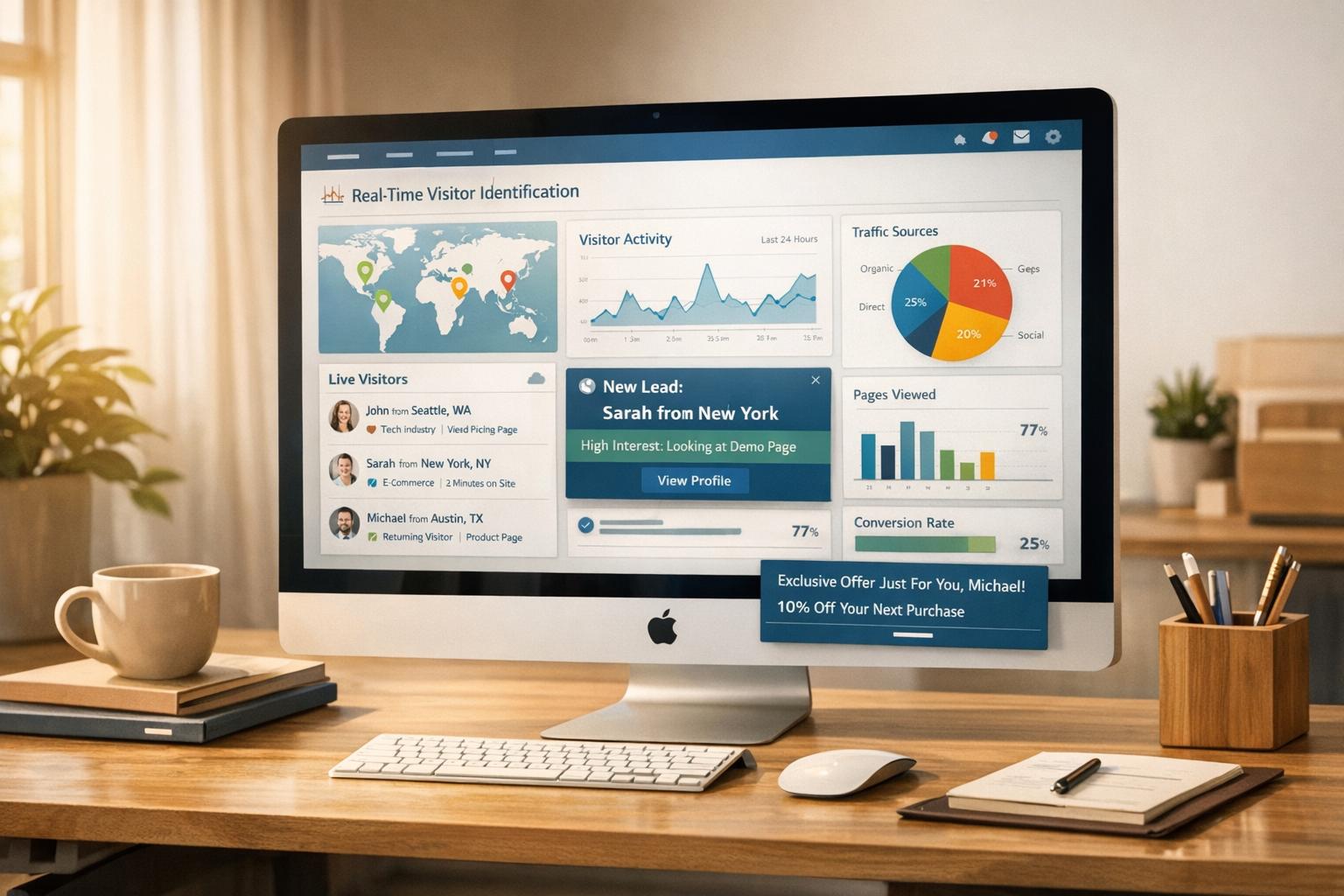
Every month, up to 98% of website visitors remain unidentified, leaving businesses blind to potential revenue. Despite heavy investments in ads, SEO, and content marketing, only about 2–3% of visitors take action, such as filling out forms or making purchases. This means businesses are losing out on high-intent leads - around 9.8% of visitors are ready to buy, but there’s no way to follow up without identifying them.
Key takeaways:
- Cart abandonment averages 70.22%, leading to $4 trillion in global revenue loss annually.
- Traditional tools like Google Analytics focus on sessions, not individuals, missing 70% of visitors even with reverse IP lookup.
- Solutions like MagicTag allow businesses to gather real-time visitor data, even from abandoned forms, and sync it with CRMs to recover leads.
By identifying and re-engaging anonymous visitors, companies have seen:
- 25–30% increases in recovery rates and conversions.
- Lower customer acquisition costs and faster sales cycles.
- Examples: Mailer Profit Agency added $1.7M in revenue, and Kut from the Kloth generated $107,000 in 30 days.
The solution is simple: Implement tools like MagicTag to track visitors, integrate with CRMs, and automate recovery workflows. Even identifying 5% more visitors can lead to a 30% jump in monthly leads. Don’t let anonymous traffic cost you - turn those visitors into customers today.

The Cost of Anonymous Website Traffic: Key Statistics for SaaS and E-commerce
Calculating the Financial Impact of Anonymous Traffic
Lost Revenue from Unidentified Leads and Cart Abandonment
The numbers around cart abandonment in e-commerce are staggering. On average, 70.22% of online shopping carts are abandoned. This figure climbs even higher in the fashion industry, hitting 77%, with mobile users abandoning their carts at an even more alarming rate of 80.2%. Considering that mobile accounts for nearly 80% of fashion traffic, these abandonment rates contribute to a global loss of approximately $4 trillion every year .
Let’s break it down further. Imagine your site sees 10,000 visitors each month. Out of these, 980 visitors show clear buying intent, but only 300 end up engaging, based on the average SaaS conversion rate of 3% . That’s a huge gap in potential revenue. For example, in 2022, Chronus realized that a whopping 85% of their net-new pipeline stemmed from anonymous visitors they had previously overlooked. Similarly, Kut from the Kloth achieved $107,000 in added revenue in just 30 days by identifying and reconnecting with anonymous visitors, yielding an impressive 48x ROI.
These examples highlight a critical issue: traditional analytics tools often fail to bridge this revenue gap, leaving businesses blind to the opportunities hidden in their anonymous traffic.
Why Traditional Analytics Tools Fall Short
While tools like Google Analytics offer insights into metrics like page views and bounce rates, they fall short when it comes to identifying the people behind the data. As OpenSend explains:
"Google Analytics is diagnostic - it tells you what happened. Visitor identification is actionable - it tells you who it happened to and enables you to respond".
This is the key problem: traditional analytics focus on sessions or IP addresses, not actual individuals you can follow up with. Even reverse IP lookup, one of the most widely used methods for identifying visitors, only succeeds in identifying about 30% of them, leaving 70% completely out of reach. Without the ability to connect with these high-intent visitors, businesses miss out on opportunities to send personalized cart recovery emails, calculate the revenue lost from these abandonments, or prioritize their most promising prospects for follow-up. This "identity gap" is a major blind spot that costs businesses significant revenue every day.
Capturing Lead Data in Real-Time
How Form-Based Data Capture Works
One of the most effective ways to recover lost leads is by capturing data as visitors type. MagicTag records names, email addresses, and phone numbers in real time - even if the form is abandoned. For example, if a visitor enters their email in a checkout or signup form but doesn’t complete it, you still have the information needed to re-engage them. This works by tracking micro-actions and user interactions on your site.
In 2022, Harvest Hosts used real-time visitor identification to connect with high-intent anonymous visitors through personalized campaigns, cutting their Cost Per Acquisition by 28%. Likewise, Mailer Profit Agency leveraged this technology to identify previously unknown visitors, leading to $1.7M in attributable revenue. Real-time data capture like this integrates seamlessly with your CRM and marketing tools, making follow-ups fast and efficient.
Privacy Compliance and Simple Setup
MagicTag is incredibly easy to set up - just a single JavaScript snippet is all it takes. It works across all major platforms, including Shopify, WordPress, and custom-built sites.
Privacy compliance is baked into the system. MagicTag adheres to GDPR and LGPD regulations, ensuring user consent is respected and data is processed transparently. By focusing on first-party data, MagicTag meets modern privacy standards while providing actionable insights for immediate follow-ups.
Tracking Visitor Data as It Happens
With real-time dashboards, you can see exactly who’s on your site and what they’re doing. These dashboards show which pages visitors are viewing, how long they’re staying, and even their intent scores based on behavior patterns. This live data allows your sales team to act quickly on hot leads while your brand is still fresh in the visitor’s mind.
The system analyzes factors like click speed and navigation paths to predict purchase intent - sometimes within just five clicks. If a high-priority visitor lands on your pricing page or starts filling out a demo request, you’ll know immediately. Many businesses use automated alerts to notify sales reps the moment a lead shows strong buying signals, enabling them to follow up within minutes rather than days.
Connecting Lead Capture to Your CRM and Marketing Tools
Connecting with HubSpot, ActiveCampaign, Klaviyo, and Other CRMs
MagicTag simplifies the process of transferring captured lead data to your marketing tools using API webhooks. As soon as a visitor enters their email or phone number - even without clicking submit - that information is automatically sent to platforms like HubSpot, Salesforce, ActiveCampaign, Klaviyo, Mailchimp, and Customer.io.
The setup is simple. MagicTag links visitor behavior to identity data and sends it directly to your CRM, eliminating the need for manual data entry. For Klaviyo users, this integration is particularly useful - it allows you to enhance third-party data and trigger abandoned browse flows for visitors who didn’t complete a form. Instead of waiting for a checkout to happen, your email sequences can start the moment someone shows interest.
With instant webhooks, your sales team is notified the second a high-intent visitor takes action. This quick response is critical - leads contacted within five minutes are three times more likely to convert. This smooth data transfer enables automated workflows that can recover leads more effectively.
Setting Up Automated Lead Recovery Workflows
Automation kicks off with behavioral triggers - specific actions that indicate a visitor’s intent to purchase. For instance, spending extra time on your pricing page, viewing multiple product pages in one session, or abandoning a cart can all signal readiness to buy. These behaviors automatically initiate recovery workflows.
Once MagicTag syncs the lead to your CRM, the system launches coordinated email, SMS, and social media campaigns. A typical sequence might include an email sent within minutes, a LinkedIn connection request on day three, and a case study shared on day five. Businesses using these automated workflows often see a 40% drop in customer acquisition costs and a 25% faster sales cycle.
MagicTag also automates lead scoring by analyzing firmographic data (like company size or industry) and behavioral signals (such as page views or email opens). High-priority leads go straight to sales reps, while others enter nurturing campaigns. With closed-loop reporting, you can track a lead’s journey from their first anonymous visit to the final sale, giving you insight into which workflows generate the most revenue.
"Speed wins - respond to leads in seconds, not hours: automated systems capture and respond to prospects instantly, dramatically improving conversion rates compared to manual follow-up."
– Sean O'Connor, monday CRM
MagicTag Pricing Plans and Features
MagicTag offers flexible pricing plans to match your business needs, whether you’re just starting out or managing a high-volume operation. Here’s a breakdown:
| Plan | Price | Monthly User Limit | Key Features |
|---|---|---|---|
| Free | $0/year | 1,000 users | Real-time dashboard, basic webhook, email support |
| Starter | $19/month | 10,000 users | Full API and webhook access, CRM integrations, priority support |
| Business | $99/month | 50,000 users | High-volume pipelines, advanced filtering, SLA support |
| Enterprise | $299/month | 50,000+ users | Dedicated infrastructure, custom integrations, premium support |
The Free plan is perfect for small businesses, allowing up to 1,000 identified users per month. As your traffic grows, the Starter and Business plans provide the advanced tools and segmentation capabilities necessary to handle larger volumes. For companies with complex marketing stacks, the Enterprise plan offers dedicated infrastructure and custom integrations, all without requiring a developer to set up.
sbb-itb-77d5bc3
Measuring Returns from Lead Recovery
Conversion and Revenue Improvements with MagicTag
Lead recovery has a direct impact on revenue growth. Take Mailer Profit Agency, for example - they used visitor identification to pinpoint potential leads and implement highly targeted outreach, resulting in a whopping $1.7M in attributable revenue. This isn’t an isolated case. Many brands using visitor identification tools report a 25% increase in abandoned cart recovery rates and as much as a 30% boost in overall conversions.
Here’s why this matters: traditional analytics only capture about 2% of your website traffic - those who fill out forms. In contrast, lead recovery systems can identify up to 40% of your total visitors. Let’s put that into perspective. If your site gets 10,000 visitors a month, traditional methods might give you just 200 leads. But with lead recovery, you could identify 4,000 visitors. Even identifying just 5% more leads from previously anonymous traffic can drive a 30% increase in your monthly lead volume.
These are impressive results, but the real magic happens when you combine lead recovery with advanced platform features.
Growing Your Business with Advanced Features
Lead recovery doesn’t just stop at boosting revenue - it sets the stage for scalable growth. As your leads multiply, automation becomes essential. MagicTag’s higher-tier plans are designed for businesses ready to handle larger volumes without sacrificing precision. For instance, the Business plan ($99/month) offers advanced filtering and segmentation tools - perfect for teams managing over 50,000 monthly visitors and needing to focus on high-intent prospects rather than casual browsers.
A great example of this in action is BluePrint Ad Agency. By automating lead qualification based on conversation data, they managed to process over 700 leads per month while saving 52 hours of manual work every month. This freed up their sales team to zero in on qualified prospects, dramatically improving efficiency. Without automation, scaling like this would mean either hiring more staff to manually sift through leads or wasting valuable time chasing low-intent prospects.
Another key advantage? Feeding lead quality data back into ad platforms like Google Ads. This feedback loop allows algorithms to prioritize high-value keywords instead of chasing high-traffic, low-conversion terms. Add personalized retargeting ads into the mix, and you can see click-through rates soar - up to 4x higher than generic campaigns. This transforms your ad spend into a laser-focused tool, maximizing every dollar you invest.
Conclusion: Converting Anonymous Visitors into Leads
Every month, 98% of website visitors remain anonymous. Think about that - nearly all your traffic could be slipping through the cracks, representing a huge missed revenue opportunity. This is a problem no business can afford to ignore. The difference between companies that grow and those that stagnate often boils down to one key factor: how well they capture and convert that anonymous traffic.
The good news? The fix is straightforward. By adding MagicTag's tracking snippet to your website - a process that takes just five minutes - you can start collecting real-time data on visitor behavior. Pair it with your CRM, whether it's HubSpot, Klaviyo, ActiveCampaign, or another platform, and you can automate workflows to recover abandoned carts and nurture potential customers. Even better, MagicTag offers a Free plan that allows you to identify up to 1,000 users per month at no cost. That’s 1,000 leads you might otherwise lose.
And the results speak for themselves. Businesses using MagicTag have reported 25% increases in cart recovery rates and 30% boosts in overall conversions. Even identifying just 5% more visitors from your existing traffic can lead to a 30% jump in monthly leads. These aren’t just numbers - they’re proof of what happens when you stop viewing anonymous visitors as lost opportunities and start treating them as valuable prospects.
The next step is simple: sign up for MagicTag, add the tracking code to your site, and connect your CRM. Within 30 days, you’ll see how many leads you’ve been missing - and start recovering them automatically. Your visitors are already on your site. It’s time to turn them into customers.
FAQs
How can SaaS and e-commerce businesses identify and engage anonymous website visitors?
Turning anonymous visitors into potential leads starts with figuring out who they are. Tools that track IP addresses and browsing habits can provide useful details like the visitor’s company name, industry, and location. Combine this with their on-site actions - like how long they spend on certain pages or if they check out your pricing section - and you’ll have a clearer picture of which prospects are worth prioritizing and what they might be looking for.
With this information in hand, personalized engagement becomes the next step. Real-time adjustments, such as customized banners or product suggestions, can be shown based on their behavior. Offering valuable content - like whitepapers or guides - behind simple forms (just asking for a name or email) can encourage visitors to share their details. Once collected, these leads can be added to your CRM for follow-up through automated email campaigns, targeted ads, or even live chat. By identifying who’s visiting, tailoring their experience, and nurturing the connection, businesses can turn anonymous traffic into real revenue opportunities.
How does MagicTag help e-commerce businesses recover leads from anonymous visitors?
MagicTag empowers e-commerce businesses to transform anonymous website visitors into potential leads. By leveraging IP intelligence, device fingerprinting, and behavioral tracking, the platform uncovers visitor intent in real time. This means businesses can deliver personalized outreach and set up automated follow-ups, boosting conversion rates and driving a better return on investment.
What’s more, MagicTag integrates effortlessly with your CRM and other marketing tools. This seamless connection ensures that every captured lead flows directly into your sales pipeline, cutting down on manual data entry and speeding up the sales process. Its AI-driven scoring system identifies top prospects, helping your team zero in on high-value opportunities. With MagicTag, you can turn previously anonymous traffic into actionable insights - and ultimately, increased revenue.
How can capturing real-time visitor data help increase conversions?
Monitoring real-time visitor behavior helps you spot anonymous users who are highly likely to make a purchase - especially if they’re browsing important pages like pricing or product details. Acting on this information right away lets you initiate personalized outreach or prioritize these leads for follow-up, boosting your chances of turning them into paying customers.
By staying responsive, you can seize these opportunities as they arise, improving your lead generation strategy and getting the most out of your investment.