Online stores lose $4.6 trillion annually to cart abandonment, but tools like MagicTag can help recover up to $2.75 trillion of that. Here's how: MagicTag captures customer information, like emails or phone numbers, as they fill out checkout forms - even if they don't finish. This data syncs with your CRM, enabling personalized recovery campaigns that convert lost carts into sales. Businesses using MagicTag report an 85% increase in abandoned cart leads and significant boosts in revenue.
Key Takeaways:
- Why carts are abandoned: Hidden costs (48%), forced account creation (24%), and mobile checkout issues (85.65%).
- MagicTag's solution: Captures incomplete form data in real time, identifies more leads, and integrates with CRMs for instant recovery efforts.
- Proven results: Companies like Oleum Cottage saw a 54% rise in conversions, while Pura Vida generated $400,000 in new revenue using MagicTag's recovery tools.
MagicTag simplifies cart recovery with real-time tracking, automated follow-ups, and secure data handling, making it a powerful tool to recapture lost sales.
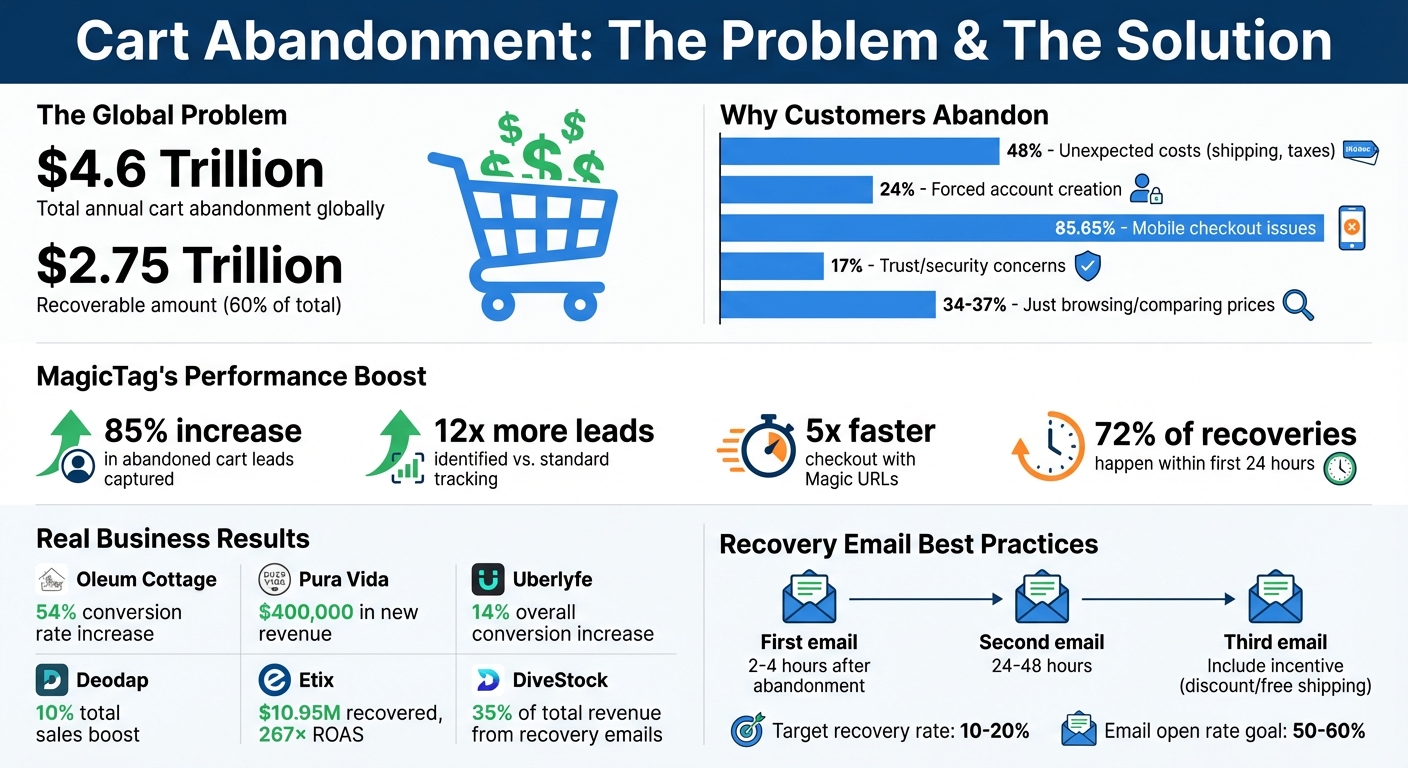
Cart Abandonment Statistics and MagicTag Recovery Results
Why Recovering Abandoned Carts Is Difficult
Why Customers Abandon Their Carts
To tackle cart abandonment, you first need to understand why shoppers leave without completing their purchase. One of the biggest culprits? Unexpected costs. About 48%–49% of customers abandon their carts when surprise charges - like shipping fees, taxes, or handling costs - pop up at checkout. That sudden price hike can stop a purchase in its tracks.
Another major frustration is forced account creation. Roughly 24% of shoppers walk away when a site insists on registration before letting them check out. Add to that the hassle of complex, multi-page checkouts, and the problem worsens. On mobile devices, where checkout processes can feel especially clunky, abandonment rates soar to 85.65%.
Trust issues also play a significant role. Around 17% of users abandon their carts because they don’t feel confident sharing payment details. Without visible security features like SSL certificates or trusted badges, customers hesitate to proceed. And then there are technical glitches - slow-loading pages or checkout crashes can drive customers away. Even a one-second delay can reduce conversion rates by 7%.
Sometimes, though, the issue isn’t urgency. Around 34%–37% of shoppers are just browsing or comparing prices. They might add items to their cart as a way to “bookmark” them for later, with no immediate intention to buy.
While understanding these reasons is crucial, the real challenge lies in tracking these visitors and finding effective ways to bring them back.
Where Standard Tracking Falls Short
Even if you know why a customer left, reaching them again isn’t as straightforward as it sounds. Traditional tracking systems only gather data after a shopper clicks "submit." If someone types in their email but doesn’t hit submit, that lead is lost entirely. This creates a massive blind spot, leaving potential recovery opportunities untapped.
To make matters worse, privacy changes by tech giants like Apple and Google have tightened the rules. With third-party cookies now restricted or blocked, it’s harder than ever to track users across sessions. And late-stage identification compounds the issue. Many native checkout systems only capture customer data at the very last step - after payment details are entered - leaving earlier abandoners unidentified.
Another hurdle is cross-device tracking. Customers often browse on their phones but complete purchases on desktops. Standard systems struggle to connect these dots, leading to fragmented data and missed chances to re-engage. In fact, most standard tracking methods only identify a small portion of site visitors, leaving the majority of cart abandoners completely anonymous.
Without clear insights into where a shopper dropped off, it’s nearly impossible to send recovery messages that feel relevant or personal. These limitations highlight the need for smarter, real-time tracking tools like MagicTag to bridge the gaps and improve recovery efforts.
How MagicTag Recovers Abandoned Carts
Real-Time Data Capture
MagicTag employs JavaScript-based technology to monitor customer input - such as email, name, or phone number - in real time. This means it collects data at every stage of checkout, even if the customer doesn’t hit “submit.” This approach provides a detailed view of where potential buyers abandon their carts, allowing businesses to identify up to 12x more leads compared to those without this functionality.
Take Oleum Cottage, for example. By tracking checkout behavior and pre-filling customer information, they were able to pinpoint abandonment stages, leading to a 54% boost in conversion rates. Similarly, Uberlyfe leveraged MagicTag’s cart abandonment insights to retarget customers, achieving a 14% increase in overall conversion rates.
What happens next? MagicTag syncs seamlessly with your CRM, turning captured data into actionable recovery efforts.
CRM and Marketing Platform Integration
When a cart is abandoned, MagicTag uses webhooks and APIs to sync the captured data with your CRM or marketing platform, enabling instant recovery campaigns. One of its standout features is Magic URLs - deep links that allow customers to pick up exactly where they left off, across any device, without re-entering their details.
Pura Vida illustrates how effective this can be. They sent a three-message push notification sequence using Magic URLs, resulting in over $400,000 in new revenue. Impressively, 62% of those sales came from the very first notification. Timing is key - sending the initial recovery message within the first hour of abandonment significantly increases the chances of re-engagement.
This streamlined integration doesn’t just recover lost leads; it directly drives revenue, all while maintaining stringent data security.
Privacy and Compliance
MagicTag’s robust privacy measures ensure customer data is handled securely. Operating on a non-custodial model, MagicTag gives users control over their own information. It leverages AWS Nitro Trusted Execution Environment (TEE) technology and key sharding to maintain high standards of data protection. Additional safeguards, like multi-factor authentication (MFA) and device verification, further enhance security.
For U.S. merchants catering to both domestic and international customers, MagicTag works with cookie consent tools and preference managers to comply with regulations like GDPR and LGPD. To ensure compliance, your privacy policy should clearly state that abandoned cart information may be used for marketing purposes. Use opt-in tick boxes (not pre-checked ones) to obtain customer consent. Adding trust signals like security badges and social proof can also reassure customers about the safety of their personal and payment information.
Setting Up MagicTag for Cart Recovery
Installation and Configuration
MagicTag simplifies cart recovery by capturing real-time data and streamlining workflows. To get started, install the SDK by running npm install magic-sdk in your terminal. For e-commerce platforms like Shopify, WooCommerce, or Magento, the integration process is often automated.
Once installed, initialize the SDK using your publishable API key. MagicTag's pre-submit tracking feature is particularly useful - it captures partial form entries, such as email addresses or phone numbers, even if the user doesn't hit "submit". Make sure you map essential form fields - especially email addresses and phone numbers formatted in E.164 - to the SDK for accurate data collection.
After the SDK is configured, set up abandonment triggers to kickstart recovery workflows immediately.
Setting Up Abandonment Triggers
Abandonment triggers are key to effective cart recovery. Start by defining clear parameters to determine when a cart is considered abandoned. For instance, mark a cart as abandoned when a customer becomes inactive - like leaving your store or closing their browser - while items remain in their cart. A common timeout setting is 10 minutes, meaning recovery automation begins 10 minutes after the customer's last activity.
For guest users, ensure you capture an email address before marking the cart as recoverable. For logged-in users, carts are typically tracked as soon as a product is added. The first recovery email should be sent between 30 minutes and 4 hours after abandonment to optimize conversion rates.
| Cart Status | Description | Trigger Condition |
|---|---|---|
| Active | Customer is currently browsing | Within the timeout period |
| Abandoned | Eligible for recovery automations | Customer inactive and timeout expired |
| Recovered | Successful recovery of a lost sale | Order completed via recovery link |
Exit-intent triggers are another effective tool. These capture lead details as soon as a user tries to leave a page with items in their cart. SMS retargeting is especially impactful, boasting a 98% open rate and 95% of messages read within three minutes.
Connecting to CRM and Automation Tools
MagicTag integrates seamlessly with CRM platforms, capturing user data throughout the checkout process and triggering automated workflows like emails or SMS messages. Events such as "Abandoned Cart" help you personalize retargeting efforts using user-level data, including purchase history and location.
One standout feature is the Magic URL, which makes follow-ups more effective. When a customer clicks this link, it launches a checkout modal with pre-filled details, speeding up the transaction process by up to 5x. Timing is crucial - 72% of customers who purchase through cart recovery emails do so within the first 24 hours. Sending three recovery emails instead of just one can boost revenue by 44%.
For best results, use a multi-channel strategy. Combine email with SMS or MMS follow-ups to increase the chances of re-engagement. Save incentives like discounts or free shipping for the second or third message to avoid encouraging customers to abandon carts just to snag a deal.
sbb-itb-77d5bc3
Improving Cart Recovery Results with MagicTag
Creating Automated Recovery Campaigns
After setting up and integrating MagicTag, you can take your cart recovery efforts up a notch with strategic, automated campaigns. A proven approach involves launching a multi-channel recovery sequence. Start with the first message 2–4 hours after cart abandonment, follow up with a second message at 24–48 hours, and finish with a final message offering a compelling incentive, like a discount code or free shipping.
For example, DiveStock saw impressive results by using automated recovery emails with clear, easy-to-read formats, generating 35% of their total revenue within 90 days. Swag Jeweller also found success with a three-email sequence. The first two emails didn’t include discounts, but the third offered a 5% discount code, which contributed to 21% of their recovered revenue.
To make these campaigns more effective, personalize each message with cart details such as product images, prices, sizes, and colors. Use your CRM to segment audiences based on factors like cart value, browsing behavior, and purchase history. For high-value carts, consider offering stronger incentives, while simpler reminders may suffice for lower-value carts to maintain profitability.
Once your campaigns are running, tracking their performance is the next critical step.
Measuring Performance
To gauge how well your recovery campaigns are working, focus on key metrics like recovery rate and transaction speed. The recovery rate - calculated by dividing the number of recovered carts by total abandoned carts - should ideally fall between 10% and 20%. For instance, Etix, a leader in online ticketing, recovered $10.95 million from 1.12 million abandoned carts over 12 months, achieving a staggering 267× return on ad spend.
Monitor other indicators like email open rates (aim for 50%–60%) and click-through rates to evaluate the effectiveness of your messaging. MagicTag’s pre-filled checkout links can also speed up transactions by up to 5×, reducing friction and boosting conversions. These kinds of data-driven adjustments have consistently improved conversion rates.
Refining Your Approach Over Time
To keep improving, continuously test and refine your campaigns. Experiment with different offers - compare dollar-based discounts (e.g., $10 off) with percentage-based ones (e.g., 10% off) to see which resonates more. In some cases, dollar-based discounts have delivered as much as $15.91 in revenue per recipient.
Pay attention to where customers drop off during checkout. If shipping is a common sticking point, try offering free shipping earlier in the process. If payment is the issue, adding trust badges can help. Uberlyfe used these insights to boost their overall conversion rate by 14%.
Segmenting your audience is another effective strategy. First-time visitors may respond well to social proof, like customer reviews or star ratings, while repeat customers often appreciate loyalty rewards or early access to new products. Additionally, adjust your abandonment timeout settings based on performance. If most recoveries occur within the first hour, shortening the trigger window can help you capture leads more quickly.
Conclusion
The strategies discussed above highlight MagicTag's role in tackling the massive revenue loss caused by cart abandonment.
Every year, cart abandonment costs U.S. e-commerce businesses billions, with a staggering $4.6 trillion left in carts globally. Out of this, an estimated $2.75 trillion is recoverable. MagicTag directly addresses this issue by capturing customer data - email, phone, and address - at every stage of the checkout process, even if the customer doesn’t fully complete their purchase. Unlike traditional methods that rely on form submissions, MagicTag identifies high-intent shoppers from the moment they click "Buy Now", increasing abandoned cart data capture by over 85%. This proactive approach is particularly important as privacy restrictions from companies like Apple and Google have made older identification methods less reliable.
The results speak for themselves. U.S. businesses have seen measurable growth with MagicTag. For example, Oleum Cottage reported a 54% rise in conversion rates, Uberlyfe achieved a 14% increase in overall conversions through targeted follow-ups, and Deodap boosted total sales by 10% using the address pre-fill feature.
MagicTag doesn’t just collect customer data - it ensures that data is actionable. By triggering immediate, targeted retargeting campaigns, MagicTag helps businesses recover lost sales. Its integration with CRM systems and the Magic URL feature speeds up the checkout process by up to five times, allowing customers to complete purchases with a single click from recovery emails. This is crucial, as 72% of recovered carts are completed within the first 24 hours. By combining real-time data capture with automated multi-channel campaigns, MagicTag turns abandoned carts into a dependable revenue stream, proving itself as an essential tool for U.S. e-commerce businesses looking to reclaim lost sales.
FAQs
How does MagicTag collect customer data without requiring form submissions?
MagicTag leverages cutting-edge tracking tools to gather customer data effortlessly - no forms required. By observing actions like clicks, browsing habits, and cart interactions, it uncovers valuable insights into your customers and their shopping behaviors.
This information is processed securely and allows you to reconnect with customers who abandon their carts. It empowers you to craft tailored marketing campaigns and boost lead recovery, all while maintaining a smooth, uninterrupted user experience.
How does MagicTag offer a unique approach to recovering abandoned carts?
MagicTag tackles cart abandonment head-on by weaving recovery efforts directly into the checkout process, sidestepping traditional methods like follow-up emails or generic retargeting ads. With real-time data at its core, MagicTag detects when a shopper is about to abandon their cart and steps in with personalized offers or easy payment options - right then and there. This approach minimizes friction and transforms potential losses into immediate sales.
On top of that, MagicTag equips merchants with a user-friendly dashboard packed with actionable insights. It helps track abandonment rates, pinpoint where customers drop off, and trigger tailored prompts - like exclusive discounts or saved-payment shortcuts - based on individual shopping behavior. By combining real-time engagement with data-driven personalization, MagicTag not only boosts recovery rates but also integrates seamlessly with existing CRM and marketing tools, making it a powerful ally in solving cart abandonment issues.
How does MagicTag protect customer data and ensure compliance with privacy laws?
MagicTag puts data privacy front and center by focusing solely on first-party data, gathered only after customers provide explicit consent. Unlike platforms that rely on third-party cookies, MagicTag steers clear of them entirely, ensuring it meets U.S. regulations like the CCPA and global standards such as the GDPR. All collected data is encrypted and securely housed within the merchant's environment, with transmissions safeguarded by TLS encryption. Plus, every interaction is logged with consent, creating a clear audit trail to meet regulatory requirements.
To make compliance effortless, MagicTag comes with built-in consent management tools that automatically adjust if a user withdraws their permission. This means businesses can easily honor "do-not-track" signals, respond to data access requests, and remain compliant - without needing extra development work. By blending consent-first data collection, server-side processing, and powerful compliance features, MagicTag helps businesses recover abandoned carts while staying fully aligned with privacy laws.