Website visitor identification is the process of revealing who visits your site, even if they don’t fill out a form. This method helps businesses recover leads and improve conversions by identifying anonymous traffic using tools like IP tracking, cookies, and real-time data capture.
Here’s what you need to know:
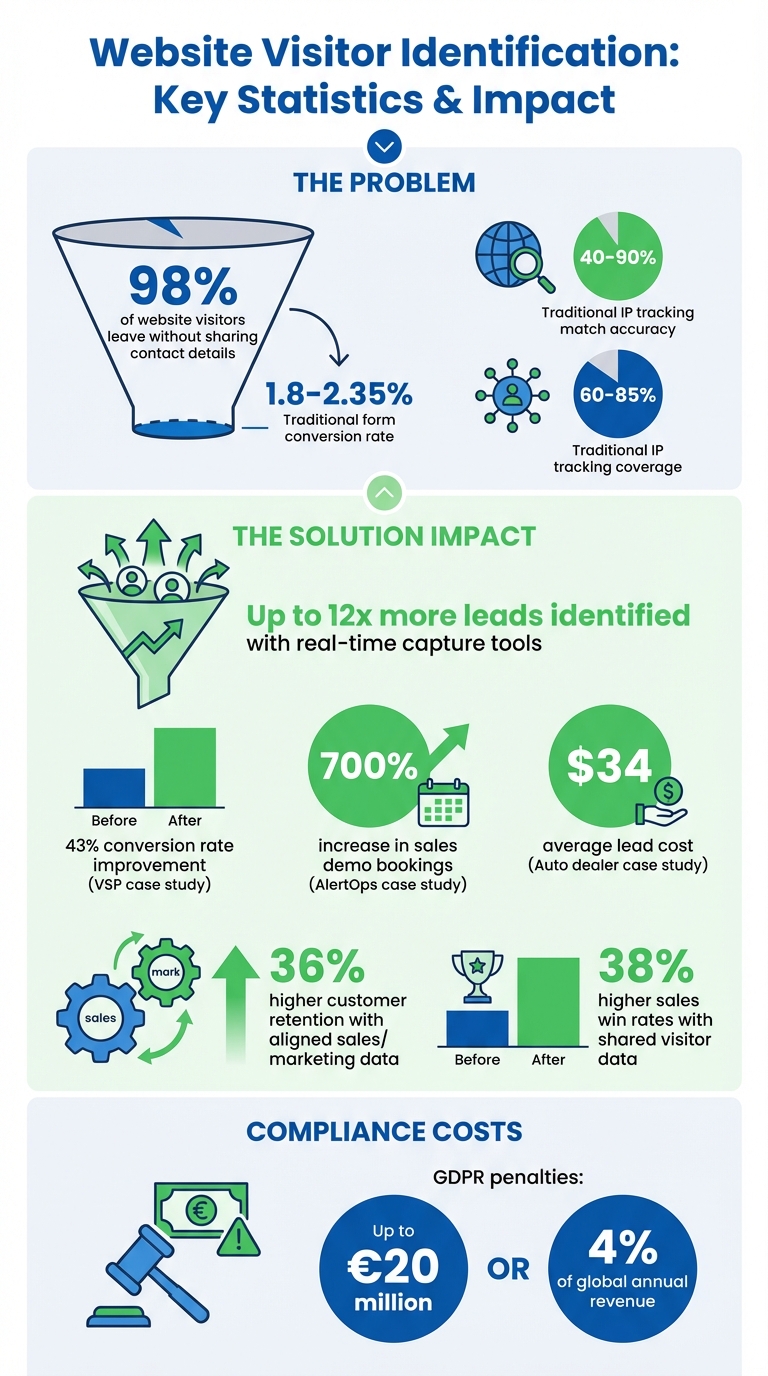
- 98% of website visitors leave without sharing contact details.
- Traditional tools like Google Analytics show metrics but fail to identify individuals.
- Visitor identification tools can reveal company names, behaviors, and even contact details.
- Compliance with privacy laws like GDPR is crucial when collecting user data.
One standout tool is MagicTag, which collects visitor information in real time - even if forms aren’t submitted. It integrates with CRMs, triggers instant follow-ups, and offers plans starting at $0/month.
This guide explains how visitor identification works, key technologies, privacy compliance, and how tools like MagicTag can help recover lost leads and boost sales.
Website Visitor Identification Statistics and Impact
How to Identify Your Anonymous Website Visitors and Boost Your Sales
How Website Visitor Identification Works
Website visitor identification relies on key technologies to analyze and profile your audience. Each approach collects unique types of data, ranging from firmographic details to on-site behavior. Here's a closer look at the methods that transform anonymous visits into actionable insights.
IP Tracking and Location Data
Every device connected to the internet has an IP address, which serves as a digital fingerprint. Visitor identification tools use reverse DNS (rDNS) to match these IP addresses with corporate databases, uncovering information like company name, industry, employee count, and headquarters location. IP tracking can identify 60–85% of website traffic with a matching accuracy of 40–90%. This data lays the groundwork for targeted marketing strategies that help recover lost leads.
Cookie-Based Tracking and User Behavior
Cookies play a crucial role in tracking visitor activities, such as which pages they view and how long they stay. These small data files also record return visits, creating a detailed picture of each visitor's journey. By linking cookies to identifiers like email addresses, businesses can track user behavior across multiple devices.
This behavioral data is a goldmine for targeted marketing. For instance, LeadPost shared a case study where a nationwide vision insurance provider improved its conversion rate by 43% using behavioral tracking. Similarly, a Virginia-based auto dealer group closed seven car sales at an average lead cost of $34 each.
| Data Point Tracked | Business Application |
|---|---|
| Pages Viewed | Personalizing content and scoring leads |
| Session Duration | Gauging engagement and purchase intent |
| Referral Source | Analyzing marketing ROI and attribution |
| Returning Visitor | Driving loyalty campaigns and sequential messaging |
Real-Time Data Capture with MagicTag
MagicTag takes visitor identification to the next level with real-time data capture. This tool collects names, emails, and phone numbers directly from form interactions - even if the visitor doesn’t hit "submit." By monitoring these interactions and securely sending the data to your CRM or marketing automation platform via webhook or API, MagicTag allows for immediate follow-up on partially completed leads.
The result? Faster and more effective lead recovery. MagicTag is designed for quick installation, works on any website, and adheres to GDPR and LGPD compliance by respecting user consent protocols. No developer assistance is required, making it a hassle-free solution for businesses looking to enhance their lead generation efforts.
Privacy Regulations and Compliance
Understanding GDPR and Consent Requirements
When using website visitor identification tools, it's essential to navigate privacy laws like the GDPR in Europe. A critical part of compliance lies in distinguishing between two types of data: personal data and business data.
Under GDPR, personal data - such as individual names, personal email addresses, and individual IP addresses - requires explicit user consent before collection. On the other hand, business data, including details like company names, industry sectors, and corporate IP ranges, is often categorized under "legitimate interest" (Article 6(1)(f) of GDPR). This allows its collection without needing a cookie banner, as long as transparency is maintained.
"The GDPR does not define what factors to take into account when deciding if your purpose is a legitimate interest. It could be as simple as it being legitimate to start up a new business activity, or to grow your business."
- Information Commissioner's Office (ICO)
Failing to comply with GDPR can lead to penalties as high as €20 million or 4% of global annual revenue. Additionally, certain tracking techniques - like cookies, device fingerprinting (which uses browser characteristics to identify users), and cross-site tracking - require explicit consent. To stay compliant, many businesses now rely on cookieless methods that use network metadata and public IP ranges for visitor identification.
| Data Category | Examples | GDPR Standard |
|---|---|---|
| Personal Data | Individual name, personal email, IP address | Explicit Consent (Opt-in) |
| Business Data | Company name, corporate IP range, industry | Legitimate Interest (Transparency + Opt-out) |
| Prohibited Tracking | Device fingerprinting, cross-site cookies | Explicit Consent (Opt-in) |
Best Practices for Responsible Data Collection
Start with transparency. Your privacy policy should clearly explain what data is collected, how it's used, and what third-party tools are involved. Keep the policy accessible - typically in your website footer - and write it in plain, user-friendly language instead of dense legal terms.
Always provide users with an easy way to opt out. When adding identified leads into your CRM, ensure the data is used responsibly and aligns with what the visitor might reasonably expect.
If you're collecting additional data through forms for marketing purposes, explicit consent is a must. As Evelyn Wolf, Co-Founder of Business Brew, puts it:
"You will need to start using a clear opt-in on all your forms whether it's an ebook download, a webinar registration or, yes, a contact us, if you plan to contact the person completing the form with any additional marketing information."
For businesses based in the EU, data residency is another important factor. To comply with Schrems II regulations, opt for vendors that store data within the EU, such as in Ireland or Frankfurt. This helps reduce risks tied to transferring data to U.S. servers. Additionally, working with vendors certified under ISO 27001:2022 ensures their information security processes are independently audited.
Next, explore how MagicTag incorporates these compliance measures to improve lead recovery.
sbb-itb-77d5bc3
Getting Started with MagicTag
Key Features of MagicTag
MagicTag collects data in real time as visitors type - even if they don't complete the form. This means you can gather names, emails, and phone numbers as soon as someone starts engaging, not just when they hit "submit."
The tool works by embedding a lightweight tracking script in your website's header. Once installed, it tracks visitor behavior, such as which pages they view, how long they stay, and what content grabs their attention. When high-value prospects visit key pages, MagicTag sends instant alerts via Slack, email, or directly to your CRM.
Integration is seamless, thanks to webhook and API connections, which allow data to flow automatically into your existing CRM or marketing tools. Plus, MagicTag is GDPR and LGPD compliant, ensuring responsible data collection practices. With MagicTag, websites can uncover up to 12x more leads compared to relying solely on traditional form submissions.
Ready to get started? Here's how to install MagicTag on your website.
Step-by-Step Installation Guide
Setting up MagicTag is quick and doesn't require a developer. After signing up, you'll receive a JavaScript snippet. Copy this code and paste it into your website's header section, typically between the <head> tags. Popular website platforms like WordPress, Shopify, and Webflow make it easy to add custom code in their settings.
Once the script is live, MagicTag starts capturing data immediately. You can then set up your webhook or API connection to send leads directly to your CRM. A real-time dashboard lets you monitor visitor interactions as they happen, eliminating the need for manual exports or waiting for batch updates.
Once you're all set up, you can choose a pricing plan that matches your website's traffic.
MagicTag Pricing Plans
MagicTag offers traffic-based pricing, charging based on the number of users identified each month rather than features or individual leads. This model grows with your business.
| Plan | Price | Monthly Users | Key Features |
|---|---|---|---|
| Free | $0 | Up to 1,000 | Real-time dashboard, basic webhook, email support |
| Starter | $19/month | Up to 10,000 | Full API + webhook, CRM integrations, priority support |
| Business | $99/month | Up to 50,000 | High-volume pipelines, advanced filtering and segmentation, SLA support |
| Enterprise | $299/month | 50,000+ | Dedicated infrastructure, custom integrations, premium support |
If you're just getting started, the Free plan is a great way to test MagicTag. Small businesses often find the Starter plan ideal for capturing abandoned leads and building remarketing lists. For high-traffic websites or complex workflows, the Business and Enterprise plans provide the advanced features and infrastructure needed to scale.
Improving Lead Recovery and Conversions
MagicTag's real-time visitor identification isn't just about gathering data - it’s about turning that data into actionable leads and higher conversions. Did you know most websites lose 98% of their visitors because those visitors don’t fill out forms? MagicTag changes the game by capturing information as visitors type, converting anonymous interactions into valuable leads. This real-time approach creates opportunities for immediate follow-ups using a variety of recovery strategies.
Recovering Cart Abandonments
Cart abandonment represents a missed opportunity to close a sale. When a visitor adds items to their cart but leaves without completing the purchase, it’s a lost conversion from someone who’s already shown interest. MagicTag steps in by capturing contact details the moment a user starts typing into any form field - even if they never hit "submit."
Consider this: In 2025, a Virginia-based automotive dealer group used this strategy to send tailored offers based on the specific vehicles visitors viewed. The result? Seven cars sold at an average marketing cost of just $34 per vehicle. Similarly, VSP, a nationwide vision insurance provider, targeted site visitors who didn’t convert, boosting their conversion rate by 43%.
Timing is everything here. Automated email sequences triggered immediately after a cart or form abandonment are incredibly effective. Including details like the exact product a visitor viewed (via dynamic content) makes your outreach feel personal and relevant, not generic. Now, let’s take this concept further by looking at automation across multiple channels.
Automating Remarketing Campaigns
Once you’ve identified your visitors, the next step is to re-engage them across various channels. MagicTag’s webhook and API integrations make this seamless by sending visitor data directly to your CRM, enabling personalized follow-ups.
For instance, Ryan Homes implemented a six-week automated drip campaign using MagicTag’s visitor data. By delivering sequential, well-timed offers, they closed on five home sales. Direct mail retargeting is another effective option, costing as little as $0.72 per postcard. To maximize results, segment your audience based on behavior. For example, someone who repeatedly visits your pricing page should receive a different message than someone who only reads your blog. Precision targeting like this ensures your campaigns resonate with the right audience.
Identifying Up to 12x More Leads with MagicTag
MagicTag takes lead generation to the next level by uncovering names, emails, and phone numbers as soon as visitors start typing. This enables your team to follow up immediately, even if a form is never submitted. Compare this to traditional form submissions, which average a conversion rate of just 1.8%.
Take AlertOps, an IT alerting startup, as an example. After integrating MagicTag with its Pipedrive CRM, the company saw a staggering 700% increase in sales demo bookings within just 30 days. Businesses that align sales and marketing efforts using shared visitor data report 36% higher customer retention and 38% higher sales win rates. By sending instant notifications to your sales team about high-intent visitors, you can reach out while the lead is still warm - before interest fades and the opportunity slips away.
Conclusion
Identifying website visitors has transformed the way businesses approach lead generation by revealing the 98% of traffic that typically goes unnoticed and unconverted. Instead of depending solely on form submissions - which average a conversion rate of just 2.35% - you can now gather visitor data in real time as they interact with your site.
MagicTag makes this process effortless by automating what once required time-consuming manual work. Traditional methods only managed match rates of about 30% through labor-intensive steps. With MagicTag, a single script collects key details like names, emails, and phone numbers, syncing them directly with your CRM. No more exporting spreadsheets or wrestling with technical setups. This streamlined approach allows for quick follow-ups and more effective conversion strategies.
Whether you're addressing cart abandonments, running remarketing campaigns, or pinpointing high-intent leads, MagicTag equips you with the tools to act fast - while your leads are still engaged.
Getting started couldn’t be easier: just embed a simple JavaScript snippet, link your CRM via webhook or API, and start identifying visitors right away. Plus, with a free plan that lets you identify up to 1,000 users each month, you can try it out without any risk and scale up as your business grows.
Don’t let 98% of your website traffic slip away. With MagicTag, you can finally see who’s visiting, understand their intent, and take action before it’s too late.
FAQs
How does MagicTag comply with GDPR and other privacy regulations?
MagicTag prioritizes privacy compliance, aligning with GDPR and other key privacy regulations. It ensures this by employing strong data protection practices, such as secure data handling, managing user consent effectively, and applying anonymization methods when needed.
On top of that, MagicTag equips businesses with tools to responsibly collect and process visitor data while staying compliant with legal standards. For a deeper understanding, users can refer to MagicTag's privacy policy and compliance resources.
What are the main advantages of using MagicTag for recovering leads?
MagicTag provides businesses with tools designed to identify and re-engage potential leads who visit their website. By analyzing visitor behavior and gathering key data, it helps you gain deeper insights into your audience, allowing for more personalized and effective outreach.
Key features include real-time visitor tracking, seamless CRM data integration, and privacy-compliant solutions. These capabilities streamline the process of transforming anonymous website visitors into actionable leads, helping you recover missed opportunities and fine-tune your marketing strategies with ease.
How does MagicTag collect real-time visitor data without requiring form submissions?
MagicTag employs cutting-edge tracking technology to gather visitor data in real time - even when no forms are submitted. Through tools like IP tracking, cookie-based identification, and smooth CRM system integration, MagicTag pinpoints crucial details about your website visitors. This means businesses can uncover insights into visitor behavior, preferences, and potential leads without interfering with the browsing experience.
Importantly, MagicTag is fully aligned with privacy regulations like GDPR, ensuring that all data collection is handled ethically and securely.